PET/CT imaging significantly impacts treatment decisions in men with recurrent prostate cancer after surgery, with both Ga-68 PSMA-11 and F-18 fluciclovine radiotracers producing similar rates of treatment plan changes around 29% to 42%, though they differ in detecting specific types of cancer recurrence.
- Treatment decision impact: PET/CT imaging changed salvage radiation therapy plans in 29% of patients using F-18 fluciclovine and 42% using Ga-68 PSMA-11
- Tracer comparison: F-18 fluciclovine detected local prostate bed recurrence at substantially higher rates, while both performed similarly for pelvic lymph node and distant site detection
- Clinical application: Accurate disease detection is critical for guiding salvage radiation therapy, which is increasingly offered at lower PSA levels after radical prostatectomy
- Study scope: EMPIRE-2 trial involved 140 men with detectable PSA levels randomized to receive either imaging tracer between May 2019 and May 2023
- Key takeaway: Optimal imaging strategy depends on understanding tracer-specific attributes and how they align with clinical objectives at different disease stages
PET/CT has a significant impact on clinical decision-making in men being considered for additional treatment after radical prostatectomy, according to a study published June 30 in Radiology.
The finding is from a trial that compared the radiotracers gallium-68 (Ga-68) PSMA-11 and F-18 fluciclovine in 140 men with detectable prostate-specific antigen (PSA) levels who were candidates for salvage radiation therapy (sRT), noted lead author Olayinka Abiodun-Ojo, MD, of Emory University in Atlanta, and colleagues.
“In postprostatectomy biochemical recurrence, the use of F-18 fluciclovine and Ga-68 PSMA-11 for PET/CT-guided sRT planning resulted in substantial treatment decision changes, but there was no difference in the likelihood of a decision change between the two radiotracers,” the group wrote.
sRT for prostate cancer recurrence after radical prostatectomy is increasingly offered at lower PSA levels, with accurate disease detection important for guiding the therapy, the authors explained. Previously, in the EMPIRE-1 trial, the group found that adding F-18 fluciclovine PET/CT-guided sRT to conventional imaging changed management decisions in 35% of participants.
Since the end of that trial, Ga-68 PSMA-11 has emerged as a tracer with greater sensitivity for detecting prostate cancer than F-18 fluciclovine PET/CT. Thus, the authors designed the current study (EMPIRE-2) to determine whether that advantage translates into more frequent or more accurate treatment decision changes.
The researchers randomly assigned 140 men with detectable PSA levels after prostatectomy to undergo either F-18 fluciclovine PET/CT (arm A, 70 men) or Ga-68 PSMA-11 PET/CT (arm B, 70 men) between May 2019 and May 2023. Radiation oncologists documented their treatment plans before and after each scan, including whether to offer sRT, which fields to treat, and whether to add a radiation boost to areas of radiotracer uptake.
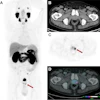
 F-18 fluciclovine PET/CT images in a 59-year-old man with biochemical recurrence after prostatectomy (prostate-specific antigen level, 0.42 ng/mL; Gleason score, 5 + 4 = 9; T3BN1M0). (A) Coronal PET and (B) maximum intensity projection images show multiple retroperitoneal lymph nodes with abnormal radiotracer uptake (arrows). (C) Axial PET and (D) axial fused PET/CT images show the index lesion (arrow), measuring 13 × 10 mm, on the right precaval lymph node. The initial decision to offer radiation therapy to the prostate bed and pelvis was changed to a decision not to offer radiation therapy. RSNA
According to the analysis, overall sRT decision changes occurred in 29% of participants in the F-18 fluciclovine arm and 42% of participants in the Ga-68 PSMA-11 arm, with no significant difference between the two groups. Among men for whom the final decision was to proceed with sRT, however, changes to the treatment field or the addition of a boost occurred more often with F-18 fluciclovine PET/CT than with PSMA-11 PET/CT, at 72% versus 54%.
In addition, F-18 fluciclovine PET/CT detected local recurrence in the prostate bed at a substantially higher rate than Ga-68 PSMA-11 PET/CT, particularly among men with very low PSA levels, while the two tracers performed similarly for detecting recurrence in pelvic lymph nodes or at extrapelvic sites.
“These findings suggest that F-18 fluciclovine and Ga-68 PSMA-PET/CT have similar benefits for sRT planning, in terms of improving cancer control without increased toxicity,” the group wrote.
In an accompanying editorial, Amir Iravani, MD, of the University of Washington in Seattle, noted that the study highlights that PET imaging, regardless of tracer, had a substantial impact on clinical decision-making. Ultimately, the optimal imaging strategy for sRT planning may depend less on selecting a single "best" tracer and more on understanding how tracer-specific attributes align with clinical objectives at distinct disease stages, he wrote.
“EMPIRE-2 provides an important framework for this nuanced interpretation, reminding clinicians that the goal of molecular imaging is not better images alone, but better-aligned decisions that improve patient outcomes,” Iravani concluded.
The full study is available here.