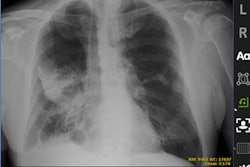
Automatically flagging suspicious chest X-rays for urgent radiologist review did not reduce time to CT or lung cancer diagnosis, according to a study published March 24 in Nature Medicine.
The finding is from one of the largest randomized trials of AI-based chest x-ray prioritization to date and included more than 93,000 primary care-referred chest x-rays across five NHS hospitals in England, noted first author Nick Woznitza, PhD, of University College London, and colleagues.
"AI prioritization of [chest x-rays] requested by U.K. primary care has no significant impact on the lung cancer pathway. Therefore, [chest x-ray] AI deployments should not include worklist prioritization in this context," the group wrote.
The U.K.’s National Health System (NHS) mandates that patients with a suspicious chest x-ray progress to CT within 72 hours, but meeting this standard remains a major challenge largely due to a deficit of radiologists and increasing workflows, the authors explained.
AI algorithms that flag abnormal chest x-rays for immediate review have been widely proposed as a scalable solution, but rigorous prospective evidence has been lacking, they noted. To that end, the researchers launched the LungIMPACT study and tested whether immediate AI prioritization (using qXR version 4.0, Qure.ai Technologies) influenced time to computed CT and lung cancer diagnosis.
The trial included patients aged 18 and older attending for primary care-requested chest x-rays at five NHS trusts between July 2023 and December 2024. AI prioritization was either on or off and was randomized by day. A total of 93,326 x-rays were included (45,987 and 47,339 in the prioritization "on" or "off" arms and a total of 13,347 CTs were identified, with 2,766 performed within 14 days of the chest x-rays.
According to the findings, the median time to CT was 53 days in both groups. Median time to lung cancer diagnosis was 44 days with AI prioritization and 46 days without, which was not significantly different (p = 0.84). When restricted to CTs performed within 14 days of chest x-rays, the median time to CT was eight days in both groups.
In addition, lung cancer was diagnosed in 558 patients, representing 0.6% of chest x-rays, and there were no significant differences in time to urgent referral, time to treatment, or stage at diagnosis.
“The LungIMPACT trial has shown that immediate AI prioritization had no impact on important clinical outcomes for patients with suspected lung cancer in the English NHS,” the group wrote.
Ultimately, AI worklist prioritization alone appears to add cost and complexity without clinical payoff, according to the authors, and they suggested that any future AI deployment strategy will need to be paired with genuine pathway redesign.
“A recommendation could be that any AI-flagged abnormality prompts an immediate human review and, if confirmed, the implementation of a downstream bundle of investigations,” the group concluded.
The full study is available here.