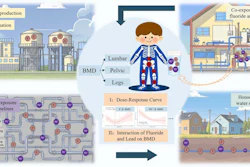
Exposure to perfluorooctanoic acid (PFOA) during childhood is associated with lower bone mineral density (BMD) in early adolescence, researchers have reported.
The finding is from an analysis in 218 children of associations between BMD Z-scores measured by dual-energy x-ray absorptiometry (DEXA) scans and serum concentrations of PFOA at delivery and ages 3, 8, and 12, noted lead author Jessie Buckley, PhD, of the University of North Carolina at Chapel Hill, and colleagues.
“Higher PFOA concentrations were associated with lower 1/3 distal radius BMD at every time point,” the group wrote. The study was published March 17 in the Journal of the Endocrine Society.
PFOA is a compound in a family of so-called “forever chemicals” called per- and polyfluoroalkyl substances (PFAS). These compounds are used widely in industrial and consumer products for their water- and stain-resistant properties, and prior studies have linked them to health issues including cancer, liver toxicity, and weakened immunity, the authors explained.
Understanding periods of heightened susceptibility to PFAS may aid in targeting interventions to reduce exposures to the chemicals during relevant life stages, the group wrote. To that end, the researchers measured serum concentrations of PFOA and three other PFAS at delivery (from cord blood) and at ages 3, 8, and 12 in a prospective pregnancy and birth cohort in Cincinnati, OH.
At age 12, participants underwent DEXA scans of six skeletal sites: whole body, lumbar spine, total hip, femoral neck, and both distal radius sites. For the analysis, the researchers calculated standardized BMD Z-scores and estimated associations between the PFAS at each time point and BMD outcomes.
According to the results, higher PFOA concentrations were associated with lower 1/3 distal radius BMD Z-scores at every time point assessed: at delivery (β: −0.39), age 3 (β: −0.36), age 8 (β: −0.54), and age 12 (β: −0.4). For other PFAS, associations differed by time point, with three-year concentrations associated with higher BMD z-scores and 8- and 12-year concentrations associated with lower BMD z-scores, particularly among girls, the researchers reported.
“We found that higher serum PFOA concentrations at multiple time points were associated with lower BMD Z-scores at the 1/3 distal radius, a predominantly cortical bone site, while associations for other PFAS differed by exposure assessment timing, skeletal site, and sex,” the group wrote.
Ultimately, the study provides critical epidemiologic evidence to support bone as a key endpoint for PFAS toxicity, the group wrote. Interventions to reduce PFAS osteotoxicity may include exposure reduction or mitigation of PFAS impacts through healthy lifestyle factors such as improved diet quality, higher calcium or dairy intake, and greater physical activity, they suggested.
"Continued research is needed to assess whether these associations persist or evolve into adulthood," the group wrote.
The full study can be found here.