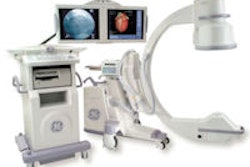
GE Healthcare of Chalfont St. Giles, U.K., plans to collaborate with partner Biosense Webster to develop a real-time ultrasound device for electrophysiology procedures, the company said.
The two firms will combine GE's ultrasound imaging technology with Biosense Webster's EP catheter technologies, GE said.
GE and Biosense have already partnered on integrating GE's CardioLab IT recording system with Biosense Webster's Carto mapping system.
Related Reading
GE focuses on high-res CT with launch of LightSpeed CT750 scanner, May 13, 2008
GE signs molecular pact with Merck, May 5, 2008
GE launches new 3-tesla MRI scanner at ISMRM, May 5, 2008
GE wins FDA nod to resume C-arm shipments, May 2, 2008
GE to build x-ray facility in Brazil, May 1, 2008
Copyright © 2008 AuntMinnie.com








![Representative example of a 16-year-old male patient with underlying X-linked adrenoleukodystrophy. (A, B) Paired anteroposterior (AP) chest radiograph and dual-energy x-ray absorptiometry (DXA) report shows lumbar spine (L1 through L4) areal bone mineral density (BMD). The DXA report was reformatted for anonymization and improved readability. The patient had low BMD (Z score ≤ −2.0). (C) Model (chest radiography [CXR]–BMD) output shows the predicted raw BMD and Z score in comparison with the DXA reference standard, together with interpretability analyses using Shapley additive explanations (SHAP) and gradient-weighted class activation maps. The patient was classified as having low BMD, consistent with the reference standard. AM = age-matched, DEXA = dual-energy x-ray absorptiometry, RM2 = room 2, SNUH = Seoul National University Hospital, YA = young adult.](https://img.auntminnie.com/mindful/smg/workspaces/default/uploads/2026/04/ai-children-bone-density.0snnf2EJjr.jpg?auto=format%2Ccompress&fit=crop&h=112&q=70&w=112)


