The type of cardiac imaging used for preprocedural revascularization planning shifted substantially between 2016 and 2024, with an increase in the use of advanced modalities and a decrease in stress echocardiography, researchers have reported.
Demographic disparities reveal modality-specific patterns, "underscoring the need for targeted interventions," wrote a team led by Reuben Odai, MD, of the University of Kansas School of Medicine-Wichita. The findings were published April 15 in the International Journal of Cardiovascular Imaging.
Noninvasive cardiac testing is critical for evaluating patients for coronary revascularization, the investigators noted. But comprehensive population-level data on utilization patterns and demographic disparities are limited. To this end, they explored trends in noninvasive cardiac testing among patients undergoing coronary revascularization and assessed for any variations across demographic subgroups.
Odai and colleagues conducted a study that used data from the TriNetX Research Network, including information from 554,855 adults between the ages of 18 and 90 years who underwent percutaneous coronary intervention or coronary artery bypass grafting at 75 healthcare organizations. They analyzed use trends for stress echocardiography, cardiac CT angiography (CCTA), cardiac MRI, SPECT, and PET.
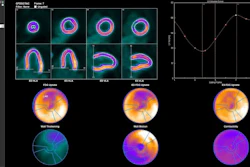
The team found that SPECT was the prominent modality for pre-procedural revascularization planning, and that over the course of the study timeframe, CCTA use increased fivefold, cardiac MRI use nearly tripled, and PET use increased fivefold. Use of stress echocardiography decreased by 26%.
Use trends of cardiac imaging pre-coronary revascularization, 2016 to 2024 | ||
Modality | 2016 | 2024 |
| SPECT | 3.5% | 5.7% |
| CCTA | 0.5% | 2.2 |
| Cardiac MRI | 0.3% | 0.8% |
| PET | 0.1% | 0.7% |
| Stress echocardiography | 1.2% | 0.9% |
Odai's group found that women showed higher incidence of SPECT and CCTA imaging compared to men (SPECT, 6.2% compared to 5.5% and CCTA, 2.3% compared to 2.1%). Men had higher incidence of cardiac MRI compared to women (0.8% versus 0.7%). The authors also reported that incidence of cardiac MRI was highest in adolescents (58.8%), while SPECT predominated in patients between the ages of 65 and 79 years (5.7% to 6%).
Finally, the study revealed that SPECT utilization was lowest in Asian patients (3.4% versus 6.2% in white counterparts), while cardiac MRI was highest in Black patients (1.1% versus 0.8% in white patients), leading the team to conclude that, while the overall trajectory reflects meaningful clinical adoption of advanced imaging, the modality-specific demographic disparities suggest a need for tailored efforts that will ensure equitable preprocedural cardiac evaluation across all patient populations.
Access the full study here.