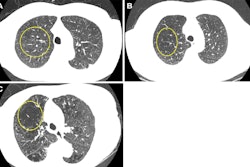
The progression of centrilobular emphysema (CLE) appears to be linked to the progression of coronary artery calcification (CAC) among low-dose CT (LDCT) lung cancer screening participants, researchers have reported.
The finding underscores "the value of detailed emphysema assessment in screening programs and supporting CLE as a systemic disorder with prognostic relevance," according to a group of investigators led by Jessica González, PhD, of the Biomedical Research Institute of Lleida-Dr. Pifarré Foundation in Lleida, Spain. The study results were published March 31 in Chest.
"CLE appears to be a systemic smoking-related phenotype linked to vascular injury, supporting targeted emphysema subtype assessment during LDCT screening to refine cardiovascular risk stratification," the group wrote.
LDCT for lung cancer screening helps clinicians evaluate smoking-related comorbidities such as emphysema and coronary artery calcification (CAC), the investigators explained. They noted that, although "cross-sectional associations exist, the long-term relationship between emphysema subtypes and CAC progression remains undefined."
The team sought to explore whether any emphysema subtype is associated with long-term CAC progression via a study that included data from a cohort of 9,047 asymptomatic individuals at high risk of lung cancer who were enrolled in the Mount Sinai Early Lung and Cardiac Action Program between June 2000 and August 2004. The group used information from 256 of the total participants who had 15 years or more of follow-up, and visually assessed and graded the presence of emphysema and its two subtypes, centrilobular and paraseptal, using the Fleischner Society classification. The researchers tracked participants' CAC scores, defining "progression" as any increase in total score from baseline to follow-up.
Of the 256 participants included in this research, 69.1% were former smokers at enrollment, with a median of 31.1 pack-years.
González and colleagues reported the following:
- They observed progression of CAC in 182 (71.7%) and progression of emphysema in 145 (56.6%) participants over a median follow-up of 18.3 years.
- Participants with CAC progression had higher rates of any emphysema compared to those who did not, both at baseline (70.9% versus 54.2%) and at follow-up (75.8% versus 56.9%).
- Participants with CAC progression also showed higher median centrilobular emphysema scores at baseline (two versus zero; p < 0.001) and follow-up (five versus zero; p < 0.001).
- In multivariable logistic regression adjusted for age, smoking status, and pack-years, centrilobular emphysema progression was strongly associated with CAC progression (OR 3.32; p < 0.001).
Paraseptal emphysema did not show association with CAC progression, the researchers wrote.
The study provides "novel evidence suggesting that CLE is not only a distinct emphysema subtype but is also associated with the progression of CAC, supporting a potential link between pulmonary and cardiovascular disease," according to González and colleagues.
"Future studies in larger cohorts, incorporating spirometric measurements and detailed cardiovascular outcomes, are required to confirm these results and to determine whether early recognition and targeted interventions in CLE can modify both respiratory and cardiovascular outcomes," they concluded.
Access the full study here.