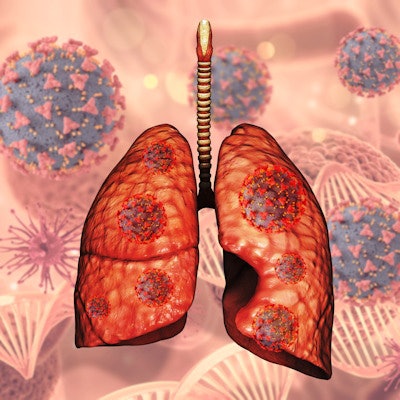
CT helps clinicians assess the long-term effects of COVID-19 on the lungs, according to a literature review published June 6 in Academic Radiology.
The findings underscore the need to track patients' ongoing recovery from the disease, wrote a team led by Sanam Alilou, MD, of Iran University of Medical Sciences in Tehran.
"There is rising concern regarding the increased prevalence of COVID-19-recovered patients for ongoing pulmonary sequelae and fibrosis," the group noted. "Imaging predictors are critical for the early detection and management of individuals with pulmonary sequelae."
In the aftermath of the acute phase of the COVID-19 pandemic, it appears that about 10% of those who contracted the diseases experience "long COVID" -- that is, symptoms that persist for weeks or months. These symptoms range from mild to acute.
The group conducted a literature review, culling 11 studies from PubMed, EMBASE, and Web of Science published through November 2022 that reported on the predictive value of radiological findings in patients with post-COVID-19 lung residuals. The studies represented 1,777 individuals positive for COVID-19, all of which underwent chest CT (in two of the studies, patients also underwent chest x-ray and lung ultrasound).
The group found that the following factors were associated with post-COVID-19 lung sequelae:
- Higher CT severity scores
- High Radiographic Assessment of Lung Edema (RALE) score
- Higher interstitial scores
- Higher lung ultrasound scores
- The presence of patchy opacities
- Abnormal chest x-ray
- The presence of pleural traction
- The presence of subpleural abnormalities
Higher CT severity scores and consolidations were the most common predictive factors for lung sequelae among patients who had contracted COVID-19, the team reported, noting that "pulmonary residuals in patients with initial consolidation are about four times more likely than in patients without this finding," with an odds ratio of 3.8 (with 1 as reference).
The review's findings should help clinicians effectively care for patients who have had COVID-19 but continue to experience symptoms, according to the researchers.
"This review will contribute to a better understanding of the potential long-term pulmonary sequelae of COVID-19 and help with the early detection and intervention to prevent or attenuate the advancement of lung fibrosis," they concluded. "However, further research to better understand the underlying mechanisms of pulmonary fibrosis development in COVID-19 patients is warranted."
The complete study can be found here.