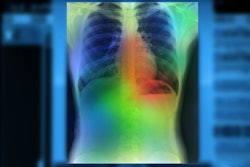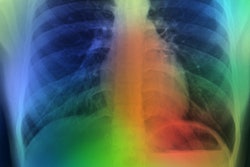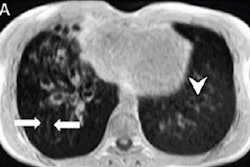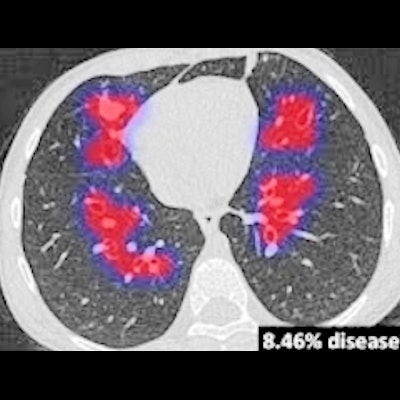
Software developer Thirona is launching Pragma-AI, a new artificial intelligence (AI) algorithm to provide automated analysis of CT scans of patients with cystic fibrosis (CF) and detect and quantify lung abnormalities.
Pragma-AI is an update on the company's previously released Pragma-CF algorithm, which offers a quantitative method for assessing cystic fibrosis lung disease on CT scans. But the company noted that Pragma-CF took up to several hours per patient and required highly trained data analysts.
Original CT scan (left) and overlay (heat map; right) of disease areas in the lungs of a CF patient and healthy control, determined in several seconds by Thirona's new Pragma-AI software. Image courtesy of Thirona.With Pragma-AI, Thirona has automated the method so that analysis of CT scans of cystic fibrosis patients can be performed in several seconds without human interference, the company stated.
Cystic fibrosis is a rare genetic disorder with approximately 70,000 known cases worldwide, characterized by severe lung problems and reduced life expectancy.


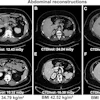
![Axial images from unenhanced calcium score cardiac CT (left) and curved planar reformation images from CT angiography (right) show that higher long-term exposure to air pollution is associated with greater coronary artery calcium and more obstructive coronary artery disease (CAD). Top row: Images in a 68-year-old male patient with higher 10-year mean ambient air pollution exposure (7.9 μg/m3 for particulate matter measuring ≤2.5 μm in diameter [PM2.5] and 17.4 parts per billion [ppb] for NO2) with extensive CAD (coronary artery calcium score [CACS] >1,000 and obstructive CAD [≥70% diameter stenosis]). Bottom row: Images in a 57-year-old female patient with lower 10-year mean ambient air pollution exposure (6.3 μg/m3 for PM2.5 and 4.6 ppb for NO2) with no CAD (CACS = 0 and no obstructive stenosis).](https://img.auntminnie.com/mindful/smg/workspaces/default/uploads/2026/06/hanneman.r6SMLzkezo.png?auto=format%2Ccompress&fit=crop&h=100&q=70&w=100)


![Axial images from unenhanced calcium score cardiac CT (left) and curved planar reformation images from CT angiography (right) show that higher long-term exposure to air pollution is associated with greater coronary artery calcium and more obstructive coronary artery disease (CAD). Top row: Images in a 68-year-old male patient with higher 10-year mean ambient air pollution exposure (7.9 μg/m3 for particulate matter measuring ≤2.5 μm in diameter [PM2.5] and 17.4 parts per billion [ppb] for NO2) with extensive CAD (coronary artery calcium score [CACS] >1,000 and obstructive CAD [≥70% diameter stenosis]). Bottom row: Images in a 57-year-old female patient with lower 10-year mean ambient air pollution exposure (6.3 μg/m3 for PM2.5 and 4.6 ppb for NO2) with no CAD (CACS = 0 and no obstructive stenosis).](https://img.auntminnie.com/mindful/smg/workspaces/default/uploads/2026/06/hanneman.r6SMLzkezo.png?auto=format%2Ccompress&fit=crop&h=112&q=70&w=112)