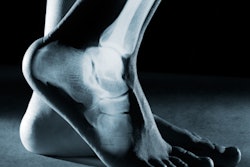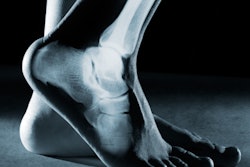
Imaging device vendor CurveBeam said it will debut its new CubeVue Autometrics artificial intelligence (AI) segmentation software for foot and ankle CT scans at next month's American Academy of Orthopaedic Surgeons meeting in Orlando, FL.
CubeVue Autometrics uses deep-learning AI algorithms to automatically identify and segment foot and ankle CT scans in under two minutes. After segmentation is complete, the software can display the scans as 3D renderings and multiplanar reconstructions. The fully automated AI algorithm was trained on 300 datasets of foot and ankle CT exams.
Diagnostic examination of foot and ankle bone injuries and diseases often relies on manual segmentation of CT scans, which is a time-consuming process. With CubeVue Autometrics, clinicians can apply software tools to automatically segmented CT datasets and obtain measurements of bone angles that are critical for identifying foot and ankle deformities, CurveBeam said.
The AI segmentation platform also offers automated CT measurements of hindfoot alignment in 3D as well as of the air space between the tibia and fibula for assessing syndesmosis injury.





![Axial images from unenhanced calcium score cardiac CT (left) and curved planar reformation images from CT angiography (right) show that higher long-term exposure to air pollution is associated with greater coronary artery calcium and more obstructive coronary artery disease (CAD). Top row: Images in a 68-year-old male patient with higher 10-year mean ambient air pollution exposure (7.9 μg/m3 for particulate matter measuring ≤2.5 μm in diameter [PM2.5] and 17.4 parts per billion [ppb] for NO2) with extensive CAD (coronary artery calcium score [CACS] >1,000 and obstructive CAD [≥70% diameter stenosis]). Bottom row: Images in a 57-year-old female patient with lower 10-year mean ambient air pollution exposure (6.3 μg/m3 for PM2.5 and 4.6 ppb for NO2) with no CAD (CACS = 0 and no obstructive stenosis).](https://img.auntminnie.com/mindful/smg/workspaces/default/uploads/2026/06/hanneman.r6SMLzkezo.png?auto=format%2Ccompress&fit=crop&h=100&q=70&w=100)


![Axial images from unenhanced calcium score cardiac CT (left) and curved planar reformation images from CT angiography (right) show that higher long-term exposure to air pollution is associated with greater coronary artery calcium and more obstructive coronary artery disease (CAD). Top row: Images in a 68-year-old male patient with higher 10-year mean ambient air pollution exposure (7.9 μg/m3 for particulate matter measuring ≤2.5 μm in diameter [PM2.5] and 17.4 parts per billion [ppb] for NO2) with extensive CAD (coronary artery calcium score [CACS] >1,000 and obstructive CAD [≥70% diameter stenosis]). Bottom row: Images in a 57-year-old female patient with lower 10-year mean ambient air pollution exposure (6.3 μg/m3 for PM2.5 and 4.6 ppb for NO2) with no CAD (CACS = 0 and no obstructive stenosis).](https://img.auntminnie.com/mindful/smg/workspaces/default/uploads/2026/06/hanneman.r6SMLzkezo.png?auto=format%2Ccompress&fit=crop&h=112&q=70&w=112)