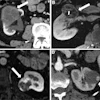
The American College of Radiology (ACR) Committee on Incidental Findings updated its recommendations for managing incidental liver lesions found on CT. The new guidelines were published online September 16 in a white paper in the Journal of the American College of Radiology.
Drawing from published data and expert opinion, the committee updated an algorithm for handling incidental liver lesions found in asymptomatic adult patients on CT scans. The algorithm should not be applied to the management of previously suspected or known lesions, noted lead author Dr. Richard Gore and colleagues. The table below provides an overview of the algorithm.
| Algorithm for managing incidental liver lesions found on CT | |||||
| Course of action | Low-risk patients | High-risk patients | |||
| Lesion size < 1 cm | Lesion size ≥ 1 cm | Lesion size < 1 cm | Lesion size ≥ 1 cm | ||
| Observation | Generally benign | If benign features | If suspicious features | Generally benign | Usually suspicious or flash-filling features |
| Management | No additional workup | No additional workup | Prompt MRI | MRI advised in 3-6 months | Prompt MRI or biopsy |
These are recommendations and should not be viewed as "standard of care," according to the committee. The group hopes that this update will ultimately minimize the amount of unnecessary patient workup.