Canon has completed its acquisition of Toshiba Medical Systems after the deal cleared regulatory approvals in all the countries where the companies operate.
The acquisition was finalized with the passage of a resolution on December 19 at a meeting in Tokyo of Canon's board of directors. Toshiba Medical Systems now becomes a subsidiary of Canon, which already operates in medical imaging in the digital radiography segment.
Toshiba Medical's parent company decided to sell the medical business after an accounting fraud scandal engulfed the company in 2015. It reached a $6 billion deal with Canon in March 2016.
Canon said the acquisition was part of the company's five-year plan for growth that was launched earlier this year, in which Canon plans to grow through a "grand strategic transformation." In particular, Canon plans to "cultivate its healthcare business" as part of the plan.
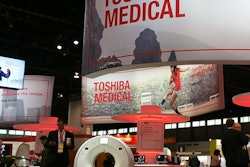
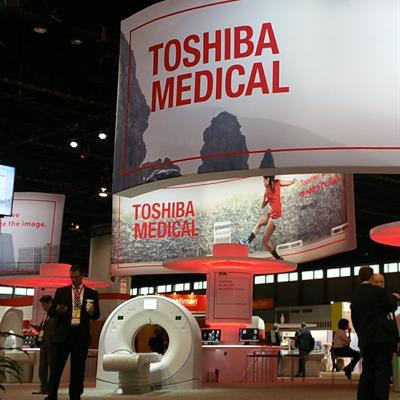
 Toshiba Medical's booth at RSNA 2016.
Toshiba has "an overwhelming market share" in Japan in CT scanners and has also been growing its global CT market share. The company has the broadest medical imaging product portfolio in Japan, with diagnostic x-ray, MRI, ultrasound, and nuclear medicine systems, according to Canon. It also participates in the in vitro diagnostics segment, the company noted.
The Toshiba Medical acquisition is expected to offer several benefits:
- Accelerated entry into new fields: Canon will be able to reinforce Toshiba Medical's strengths in in vitro diagnostics and medical information technology through mergers and acquisitions and other strategic investments, strengthening Canon's biomedical business. Canon will also make its business portfolio and partnerships available to Toshiba Medical.
- Improvements in quality through shared production technology: The combined entity will endeavor to merge Canon's advanced production technologies with Toshiba's product development capabilities, with an emphasis on precision design and microfabrication technologies, development of an optimized production system, and quality improvement.
- Expand business domains by enhancing R&D capabilities: Canon will leverage its own technologies along with Toshiba's R&D capabilities to develop innovative new products and services. Canon technologies include those in dynamic image sensors, photoacoustic tomography, medical robotic systems, and minimally invasive products.
Canon noted that Toshiba Medical had sales for the year ending March 2016 of $2.495 billion, with operating profit of $70.4 million and net income of $140.3 million.