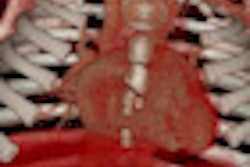
The U.S. Centers for Medicare and Medicaid Services should cover CT colonography (CTC) for Medicare patients, the American College of Radiology (ACR) wrote in a March 2 letter to President Barack Obama.
President Obama underwent CT colonography, also known as virtual colonoscopy, in a recent annual physical exam. The procedure is less invasive than standard colonoscopy and doesn't require sedation.
"You have yourself publicly addressed the importance of screening for colorectal cancer and have also stated that every American should have access to the same level of care that you receive," wrote Dr. James Thrall, chair of Reston, VA-based ACR's Board of Chancellors. "Medicare coverage of CT colonography would be a tremendous leap forward in the battle against one of the nation's leading cancer killers."
Related Reading
ACG to Obama: Colonoscopy better than virtual exam, March 4, 2010
Obama gets virtual colonoscopy, keeps presidential powers, March 1, 2010
VC CAD application does well alone and as reader aid, February 15, 2010
Editorial: CMS unfairly held VC to higher standard, February 5, 2010
VC screening maintains performance in Medicare population, November 9, 2009
Copyright © 2010 AuntMinnie.com



![Images show the pectoralis muscles of a healthy male individual who never smoked (age, 66 years; height, 178 cm; body mass index [BMI, calculated as weight in kilograms divided by height in meters squared], 28.4; number of cigarette pack-years, 0; forced expiratory volume in 1 second [FEV1], 97.6% predicted; FEV1: forced vital capacity [FVC] ratio, 0.71; pectoralis muscle area [PMA], 59.4 cm2; pectoralis muscle volume [PMV], 764 cm3) and a male individual with a smoking history and chronic obstructive pulmonary disorder (COPD) (age, 66 years; height, 178 cm; BMI, 27.5; number of cigarette pack-years, 43.2, FEV1, 48% predicted; FEV1:FVC, 0.56; PMA, 35 cm2; PMV, 480.8 cm3) from the Canadian Cohort Obstructive Lung Disease (i.e., CanCOLD) study. The CT image is shown in the axial plane. The PMV is automatically extracted using the developed deep learning model and overlayed onto the lungs for visual clarity.](https://img.auntminnie.com/mindful/smg/workspaces/default/uploads/2026/03/genkin.25LqljVF0y.jpg?auto=format%2Ccompress&crop=focalpoint&fit=crop&h=100&q=70&w=100)


![Images show the pectoralis muscles of a healthy male individual who never smoked (age, 66 years; height, 178 cm; body mass index [BMI, calculated as weight in kilograms divided by height in meters squared], 28.4; number of cigarette pack-years, 0; forced expiratory volume in 1 second [FEV1], 97.6% predicted; FEV1: forced vital capacity [FVC] ratio, 0.71; pectoralis muscle area [PMA], 59.4 cm2; pectoralis muscle volume [PMV], 764 cm3) and a male individual with a smoking history and chronic obstructive pulmonary disorder (COPD) (age, 66 years; height, 178 cm; BMI, 27.5; number of cigarette pack-years, 43.2, FEV1, 48% predicted; FEV1:FVC, 0.56; PMA, 35 cm2; PMV, 480.8 cm3) from the Canadian Cohort Obstructive Lung Disease (i.e., CanCOLD) study. The CT image is shown in the axial plane. The PMV is automatically extracted using the developed deep learning model and overlayed onto the lungs for visual clarity.](https://img.auntminnie.com/mindful/smg/workspaces/default/uploads/2026/03/genkin.25LqljVF0y.jpg?auto=format%2Ccompress&crop=focalpoint&fit=crop&h=112&q=70&w=112)