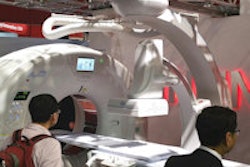
As part of a plan aimed at revitalizing the company after an accounting scandal and a forecasted 2015 loss of 550 billion yen ($4.5 billion U.S.), Toshiba is planning to sell a majority stake in its profitable Medical Systems division and focus on its energy and storage businesses.
While Toshiba Medical Systems has achieved high profitability and a global presence in diagnostic imaging, further business growth requires allocation of sufficient resources for research and development and other activities, Toshiba President and CEO Masahi Muromachi said at a December 21 press conference.
To help Toshiba Medical Systems fully realize its potential and maximize its value, Toshiba believes it's best to invite outside majority shareholders to provide sufficient support for the business, according to an English translation provided by Toshiba of Muromachi's comments. This sale would also strengthen the parent company's balance sheet, and Toshiba will give "immediate priority" to executing this plan, he said.
Toshiba Medical Systems is forecasted to have 2015 net sales of 440 billion yen ($3.64 billion), up 7% from the 412.5 billion yen ($3.4 billion) in net sales reported in 2014. The firm expects to have 2015 operating income of 15 billion yen ($123.9 million), down from 23.9 billion yen ($197.4 million) last year.

![Representative example of a 16-year-old male patient with underlying X-linked adrenoleukodystrophy. (A, B) Paired anteroposterior (AP) chest radiograph and dual-energy x-ray absorptiometry (DXA) report shows lumbar spine (L1 through L4) areal bone mineral density (BMD). The DXA report was reformatted for anonymization and improved readability. The patient had low BMD (Z score ≤ −2.0). (C) Model (chest radiography [CXR]–BMD) output shows the predicted raw BMD and Z score in comparison with the DXA reference standard, together with interpretability analyses using Shapley additive explanations (SHAP) and gradient-weighted class activation maps. The patient was classified as having low BMD, consistent with the reference standard. AM = age-matched, DEXA = dual-energy x-ray absorptiometry, RM2 = room 2, SNUH = Seoul National University Hospital, YA = young adult.](https://img.auntminnie.com/mindful/smg/workspaces/default/uploads/2026/04/ai-children-bone-density.0snnf2EJjr.jpg?auto=format%2Ccompress&fit=crop&h=100&q=70&w=100)


![Representative example of a 16-year-old male patient with underlying X-linked adrenoleukodystrophy. (A, B) Paired anteroposterior (AP) chest radiograph and dual-energy x-ray absorptiometry (DXA) report shows lumbar spine (L1 through L4) areal bone mineral density (BMD). The DXA report was reformatted for anonymization and improved readability. The patient had low BMD (Z score ≤ −2.0). (C) Model (chest radiography [CXR]–BMD) output shows the predicted raw BMD and Z score in comparison with the DXA reference standard, together with interpretability analyses using Shapley additive explanations (SHAP) and gradient-weighted class activation maps. The patient was classified as having low BMD, consistent with the reference standard. AM = age-matched, DEXA = dual-energy x-ray absorptiometry, RM2 = room 2, SNUH = Seoul National University Hospital, YA = young adult.](https://img.auntminnie.com/mindful/smg/workspaces/default/uploads/2026/04/ai-children-bone-density.0snnf2EJjr.jpg?auto=format%2Ccompress&fit=crop&h=112&q=70&w=112)