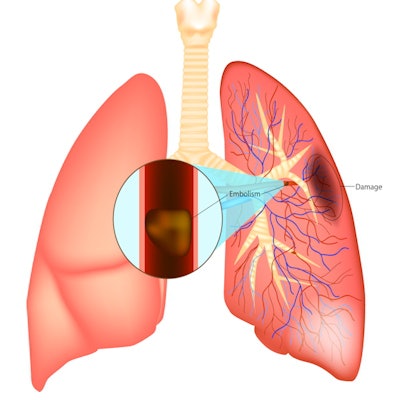
Artificial intelligence (AI) software developer Aidoc has introduced an AI-based automated notification application for high-risk pulmonary embolism (PE) patients.
The application utilizes Aidoc's AI algorithm for detecting acute PE pulmonary embolism along with right heart strain analysis to automatically flag high-risk PE patients who would benefit from interventional treatment, according to the vendor. After a patient is flagged, a notification is sent simultaneously to all relevant team members, including radiologists, pulmonologists, cardiologists, and vascular surgeons, Aidoc said. Team members can then use the package to share images, data, and text in real-time.
The software was developed by Aidoc in collaboration with radiologists at Yale School of Medicine and has been used clinically at the institution for six months, the company said.






![A normal mammogram confirmed by three-year radiologic follow-up illustrates reader-marked regions of interest (ROIs) during (A) unaided (round 1) and (B) artificial intelligence (AI)–assisted (round 2) reading. Each colored dot represents an ROI for recall by a human reader. Readers could mark more than one ROI per case, represented by multiple dots of the same color. During AI-assisted reading, the AI system displayed three visible prompts: two with suspicion of malignancy scores of 35% (left mediolateral oblique [L MLO] and craniocaudal [L CC]) and one with a suspicion of malignancy score of 10% (right craniocaudal [R CC]), shown as polygonal overlays. Without AI, six of 10 readers (60%) marked a false-positive ROI. With AI assistance, this fell to two of 10 (20%). R MLO = right mediolateral oblique.](https://img.auntminnie.com/mindful/smg/workspaces/default/uploads/2026/07/2026-07-14-radiology-mammogram-ai-auto-bias.H0bYO8QlWs.jpg?auto=format%2Ccompress&fit=crop&h=112&q=70&w=112)


