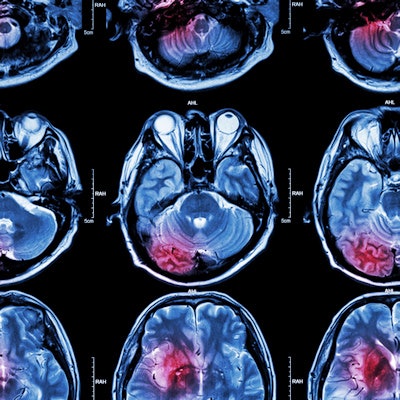
Artificial intelligence (AI) software developer Aidoc has joined forces with AI software developer Icometrix to provide AI-based stroke care.
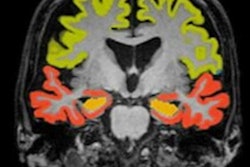
Aidoc's software will alert physicians, flagging and communicating large-vessel occlusion and intracranial hemorrhage. Icometrix's Icobrain-cva will then analyze the tissue perfusion state on CT perfusion scans in patients with ischemic stroke. The software allows for real-time sharing, viewing, and chatting, and it is customizable, according to the firms.
The collaboration will integrate Aidoc's software for identifying cervical spine fractures and Icometrix's multiple sclerosis and traumatic brain injury AI software. The two firms plan to offer users the option of Aidoc's brain aneurysm notification software as well, the companies said.






![A normal mammogram confirmed by three-year radiologic follow-up illustrates reader-marked regions of interest (ROIs) during (A) unaided (round 1) and (B) artificial intelligence (AI)–assisted (round 2) reading. Each colored dot represents an ROI for recall by a human reader. Readers could mark more than one ROI per case, represented by multiple dots of the same color. During AI-assisted reading, the AI system displayed three visible prompts: two with suspicion of malignancy scores of 35% (left mediolateral oblique [L MLO] and craniocaudal [L CC]) and one with a suspicion of malignancy score of 10% (right craniocaudal [R CC]), shown as polygonal overlays. Without AI, six of 10 readers (60%) marked a false-positive ROI. With AI assistance, this fell to two of 10 (20%). R MLO = right mediolateral oblique.](https://img.auntminnie.com/mindful/smg/workspaces/default/uploads/2026/07/2026-07-14-radiology-mammogram-ai-auto-bias.H0bYO8QlWs.jpg?auto=format%2Ccompress&fit=crop&h=112&q=70&w=112)


