Advocacy group DenseBreast-info.org has completed a health literacy update of patient educational materials on its website, revising the site's language, images, and format to make content easier for patients to understand.
The update is part of the launch of DenseBreast-info.org's Patient Advisory Group, which has urged the use of plain language in patient education materials about breast density.
"Density inform letters raise awareness about the implications of dense breast tissue, but they often are unclear about what the woman should do with the information," Chief Scientific Advisor Dr. Wendie Berg of the University of Pittsburgh said in a statement released by the organization.
DenseBreast-info.org said that changes will help women make more informed decisions about their breast health, as well as mitigate disparities caused by low health literacy.
"Low health literacy contributes to disparities in cancer care," JoAnn Pushkin, executive director of DenseBreast-info said in a statement. "Mammogram results letters can be difficult to understand and unclear... [and a] lack of understanding can impact decisions and, ultimately, outcomes. [We've] worked to balance information, delivery, and suggested action."
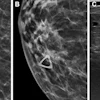
![A normal mammogram confirmed by three-year radiologic follow-up illustrates reader-marked regions of interest (ROIs) during (A) unaided (round 1) and (B) artificial intelligence (AI)–assisted (round 2) reading. Each colored dot represents an ROI for recall by a human reader. Readers could mark more than one ROI per case, represented by multiple dots of the same color. During AI-assisted reading, the AI system displayed three visible prompts: two with suspicion of malignancy scores of 35% (left mediolateral oblique [L MLO] and craniocaudal [L CC]) and one with a suspicion of malignancy score of 10% (right craniocaudal [R CC]), shown as polygonal overlays. Without AI, six of 10 readers (60%) marked a false-positive ROI. With AI assistance, this fell to two of 10 (20%). R MLO = right mediolateral oblique.](https://img.auntminnie.com/mindful/smg/workspaces/default/uploads/2026/07/2026-07-14-radiology-mammogram-ai-auto-bias.H0bYO8QlWs.jpg?auto=format%2Ccompress&fit=crop&h=100&q=70&w=100)


![A normal mammogram confirmed by three-year radiologic follow-up illustrates reader-marked regions of interest (ROIs) during (A) unaided (round 1) and (B) artificial intelligence (AI)–assisted (round 2) reading. Each colored dot represents an ROI for recall by a human reader. Readers could mark more than one ROI per case, represented by multiple dots of the same color. During AI-assisted reading, the AI system displayed three visible prompts: two with suspicion of malignancy scores of 35% (left mediolateral oblique [L MLO] and craniocaudal [L CC]) and one with a suspicion of malignancy score of 10% (right craniocaudal [R CC]), shown as polygonal overlays. Without AI, six of 10 readers (60%) marked a false-positive ROI. With AI assistance, this fell to two of 10 (20%). R MLO = right mediolateral oblique.](https://img.auntminnie.com/mindful/smg/workspaces/default/uploads/2026/07/2026-07-14-radiology-mammogram-ai-auto-bias.H0bYO8QlWs.jpg?auto=format%2Ccompress&fit=crop&h=112&q=70&w=112)