

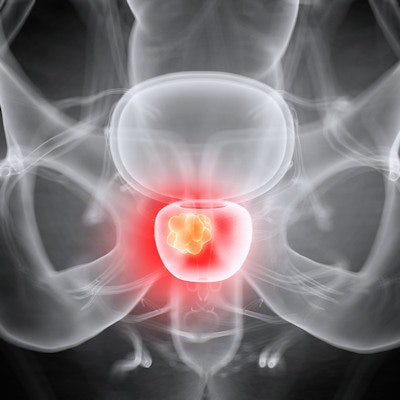
An MRI-based tool for calculating a man's risk of prostate cancer is more effective than a calculator based on Gleason scores, according to research published October 16 in the World Journal of Urology.
The research results could help urologists better assess and thus care for prostate cancer patients, lead author Dr. Marinas Hagens of Netherlands Cancer Institute in Amsterdam told AuntMinnie.com.
"The message of our study is that urologists should take the risk profile of their population into account before applying [a risk stratification tool]," he said. "If they do, risk stratification can safely prevent unnecessary MRI scans and biopsies. If they do not, either men are unfairly denied additional diagnostics or men are unfairly subjected to additional diagnostics."
Prostate cancer can be overdiagnosed, thus leading to unnecessary biopsies, according to Hagen's group. To avoid this, the European Association of Urology (EAU) recommends the use of a risk calculator to evaluate for clinically significant disease and, if indicated, to refer the patient for an MRI of the prostate. Two of these calculators are the Rotterdam Prostate Cancer Risk Calculator (RPCRC)-3/4 and the RPCRC-MRI; the former produces an estimate based on a man's Gleason score and clinical stage, while the latter is based on Prostate Imaging-Reporting and Data System (PI-RADS) scoring on MRI.
Previous research has suggested that RPCRC-MRI is the more accurate tool, but Hagens and colleagues sought to confirm this. They conducted a study that compared the two, including data from 1,575 men who underwent biopsy of the prostate between 2018 and 2021 because of suspicion of disease due to abnormal prostate-specific antigen (PSA) results. All of the men underwent an MRI exam before biopsy.
The authors analyzed the study results using original risk thresholds of 20% chance of referral for biopsy for any prostate cancer and 4% for clinically significant disease, then performed a second analysis, keeping the risk threshold the same for any prostate cancer but raising it to 10% for clinically significant disease.
Hagens' and colleagues noted that the risk stratification tools were used "as a decision aid rather than a decision-making tool."
"The decision to perform an MRI or a prostate biopsy was made in most cases based on the clinical expertise of the urologist," they wrote.
Of the total study cohort (before recalibration of risk threshold), 63.2% had prostate cancer and 41.7% had clinically significant prostate cancer. Use of the RPCRC-3/4 tool among study participants would have prevented more than a third of MRIs in the cohort but would have translated into almost 20% of missed clinically significant prostate cancer diagnoses. After recalibrating the risk threshold, use of this tool would have prevented 15.1% of MRI exams and missed 5.3% of clinically significant prostate cancers.
But the RPCRC-MRI risk assessment tool was more effective and did not need to be adjusted: Using the current threshold of 20% for any prostate cancer and 4% for clinically significant disease and tracking percentage of biopsies rather than MRI exams avoided, the team found that it would prevent 10.7% of biopsies and miss only 1.2% of clinically significant prostate cancer.
"Based on our findings, the use of the RPCRC-3/4 without recalibration is suboptimal for risk stratification in a high-risk clinical cohort and recalibration appears necessary; too many men are incorrectly stratified as low-risk based on [this tool]," the group wrote. "In contrast, risk stratification using the RPCRC-MRI has proven appropriate for use in a clinical (high-risk) cohort."
Hagens expects the study results could translate to better care for men at risk of prostate cancer, he told AuntMinnie.com.
"I hope my colleagues will, in the future, verify if the risk stratification tool they are going to use is appropriate for the population they see in their outpatient clinic," he said.

.fFmgij6Hin.png?auto=compress%2Cformat&fit=crop&h=100&q=70&w=100)

.fFmgij6Hin.png?auto=compress%2Cformat&fit=crop&h=167&q=70&w=250)


