Gallium-68 FAPI-PET/CT imaging outperforms standard F-18 FDG-PET/CT for detecting hepatopancreatobiliary cancers, identifying 16% more primary tumors and showing superior sensitivity at 93% versus 76.5% in a study of 163 patients, potentially improving cancer staging and clinical decision-making.
- FAPI-PET/CT detected 16% more primary cancers than FDG-PET/CT across hepatopancreatobiliary malignancies including liver, pancreatic, bile duct, and gallbladder cancers
- Superior sensitivity rates: FAPI achieved 93% sensitivity versus 76.5% for FDG, with 78.9% accuracy versus 68.3% in primary tumor detection
- Better lymph node staging: FAPI showed 97.2% specificity for lymph node detection compared to 69.4% for FDG, reducing false positives from inflammation
- Study details: Research analyzed 163 patients (94 bile duct, 33 gallbladder, 27 pancreatic cancer cases) who underwent both imaging types between February 2022 and October 2024
- Bile duct cancer benefit: FAPI sensitivity reached 92.8% versus 69.6% for FDG in bile duct cancer patients, showing the most pronounced improvement
Gallium-68 (Ga-68) fibroblast activation protein inhibitor (FAPI) PET/CT outperforms F-18 FDG-PET/CT in detecting hepatopancreatobiliary cancers, according to a recent study.
A group led by researchers at the Asian Institute of Gastroenterology in Hyderabad, India, conducted a head-to-head comparative analysis among 163 patients who underwent both scans, with findings supporting growing evidence that FAPI can overcome limitations of FDG.
“By identifying 16% more primary cancers than FDG and outperforming FDG for the detection of lymph nodal and distant metastases, FAPI-PET/CT could potentially improve noninvasive cancer staging, and, ultimately, clinical decision making,” the group wrote. The study was published August 12 in the European Journal of Nuclear Medicine and Molecular Imaging.
Hepatopancreatobiliary (HPB) cancers are complex malignancies that are grouped together because of their shared anatomical space and include liver cancer, pancreatic cancer, bile duct cancer, and gallbladder cancer. While F-18 FDG-PET/CT is widely used to stage patients, the technique lacks sensitivity in several HPB subtypes and generates false-positive findings from inflammation, the authors wrote.
Early studies indicate that FAPI imaging may overcome several of the recognized limitations of FDG PET/CT, yet evidence for its use in HPB malignancies remains limited, they noted. To bridge the gap, the researchers analyzed data from 163 patients who underwent both F-18 FDG-PET/CT and Ga-68 FAPI-46 PET/CT scans (Biograph Horizon, Siemens Healthineers) between February 2022 and October 2024 as part of their routine clinical evaluation for suspected HPB malignancy. The cohort included patients with bile duct cancer (n = 94), gallbladder carcinoma (n = 33), and pancreatic carcinoma (n = 27).
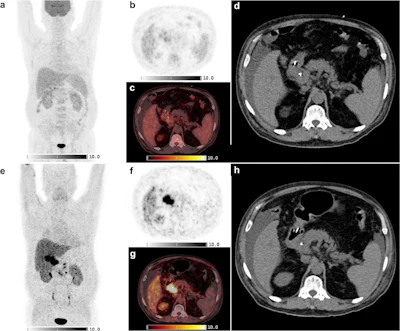
 Shown is a 69-year-old man with a cholangiocarcinoma in the distal common bile duct. F-18 FDG-PET/CT was negative where Ga-68 FAPI-46 PET/CT showed high focal FAPI uptake in the liver hilum and surrounding lymph nodes. a-d: F-18 FDG-PET/CT, e-h: Ga-68 FAPI-46 PET/CT. a, b, e, f: Maximum intensity projections, c, g: axial fusion images, d, h: non-contrast enhanced CT. European Journal of Nuclear Medicine and Molecular Imaging
“These results show great promise for clinical application of FAPI PET/CT for the detection of HPB tumors,” the group wrote.
The researchers noted that although subgroup analyses were performed, some comparisons were limited by small sample sizes. Nonetheless, the paired design and relatively large cohort provide clinically relevant comparative data, which should be validated in prospective, blinded multicenter studies, the researchers concluded.
Read the full study here.