With a flood of drugs and imaging agents in the pipeline, nuclear medicine may be at risk of fragmenting the evidence base the field needs to achieve clinical impact, according to a presentation October 20 at the European Association of Nuclear Medicine (EANM) meeting.
In a talk framed around the field’s trajectory to 2040, Roslyn Francis, PhD, of the Royal Brisbane and Women’s Hospital in Australia, cautioned that a culture of exploratory, solo-center research is undermining nuclear medicine’s ability to generate evidence for practice change, reimbursement, and patient access.
“Fragmentation in nuclear medicine research is impeding our progress,” she said.
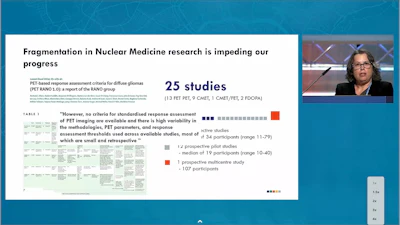
As an example, Francis noted that in 2024, an international team of experts called the Response Assessment in Neuro-Oncology (RANO) PET working group developed recommendations for PET-based response assessment criteria for diffuse gliomas, published in the Lancet Oncology. The recommendations comprise a conceptual framework to facilitate structured implementation of amino acid PET imaging in clinical research and ultimately clinical practice.
However, the group cited 25 studies covering amino acid PET imaging in the literature: 12 retrospective, 12 prospective pilot studies, and only one prospective multicenter study.
"This is not high-quality research... As such, the authors say in the paper that unfortunately there is high variability in methodologies, PET parameters, and response assessment thresholds, and the available studies are generally small and retrospective. This is fragmentation," Francis said.
Instead, she held up a a prospective, randomized, multicenter study called the proPSMA trial as a counterexample. The trial was a grant-funded Australian study led by Michael Hoffman, MD, of the Peter MacCallum Cancer Centre in Melbourne, conducted across 10 sites involving 302 men with newly diagnosed high-risk prostate cancer. Results showed that prostate-specific membrane antigen (PSMA) PET outperformed conventional bone scan and CT on accuracy, management change, radiation exposure, reporter agreement, and equivocal findings.
“It’s a slam-dunk study,” she said. "It was a study that was conducted at a time where there was fragmentation in PSMA-PET publications."
The study required collaboration among nuclear medicine, medical oncology, urology, radiation oncology, and clinical trial support. Importantly, it recruited six months ahead of schedule, was published in The Lancet in 2020, and has since supported PSMA-PET approval for the indication in the U.S., Australia, and other jurisdictions.
To replicate that impact, Francis said, multicenter trials must embed camera credentialing, standardized imaging protocols, data repositories, and centralized review from the outset. She highlighted a mutual recognition agreement on camera credentialing between top nuclear medicine societies signed at last year’s EANM meeting as a step toward enabling international collaboration.
"Data is only as good as the weakest link, and a commitment to collaboration will accelerate the impact of nuclear medicine on health outcomes. Research that makes a difference to patient care is the true measure of success," Francis concluded.
Our full coverage of EANM 2026 can be found here.