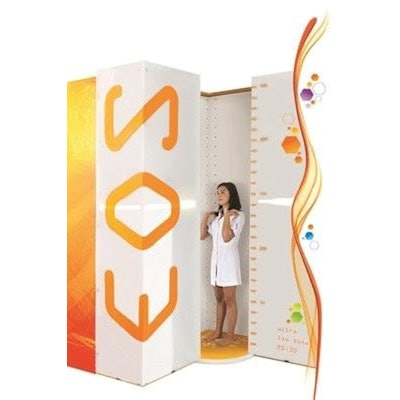
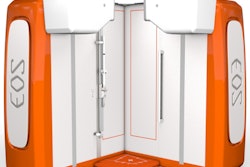
Orthopedic imaging technology developer EOS Imaging reported mixed results for its full-year 2019 (end-December 31) and its first quarter of 2020 (end-March 31).
Full-year 2019 revenue totaled 21.2 million euros ($22.9 million U.S.), down 40% from 2018's 35.4 million euros ($38.3 million). The firm sustained a net loss for the year of 18.4 million euros ($19.9 million), compared with 13 million euros ($14.1 million U.S.) in 2018.
In its first quarter of 2020, the company reported revenues of 3.8 million euros ($4.1 million), a 46% increase compared with 2019's first quarter revenues of 2.6 million euros ($2.8 million).
In other EOS Imaging news, the company announced on April 27 that Alphatec Holdings terminated the purchase offer it made in late February.








![Representative example of a 16-year-old male patient with underlying X-linked adrenoleukodystrophy. (A, B) Paired anteroposterior (AP) chest radiograph and dual-energy x-ray absorptiometry (DXA) report shows lumbar spine (L1 through L4) areal bone mineral density (BMD). The DXA report was reformatted for anonymization and improved readability. The patient had low BMD (Z score ≤ −2.0). (C) Model (chest radiography [CXR]–BMD) output shows the predicted raw BMD and Z score in comparison with the DXA reference standard, together with interpretability analyses using Shapley additive explanations (SHAP) and gradient-weighted class activation maps. The patient was classified as having low BMD, consistent with the reference standard. AM = age-matched, DEXA = dual-energy x-ray absorptiometry, RM2 = room 2, SNUH = Seoul National University Hospital, YA = young adult.](https://img.auntminnie.com/mindful/smg/workspaces/default/uploads/2026/04/ai-children-bone-density.0snnf2EJjr.jpg?auto=format%2Ccompress&fit=crop&h=112&q=70&w=112)


