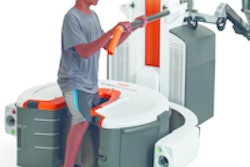
Carestream Health has launched a new version of its DRX-Evolution digital radiography (DR) system, DRX-Evolution Plus.
The new device offers a streamlined design with LED lighting, greater flexibility in high-ceiling rooms via an extended tube column, a new high-performance generator, and an optional table that accommodates patients up to 705 lb, according to the firm.
It also features a wall stand bucky-angulation capability that helps with cross-table and other complex x-ray exams; a tube touchscreen that allows technologists to change techniques and view images from the tube; pediatric tools, including automatic technique and image processing for seven pediatric body sizes; bone suppression software; a transbay option that allows for fast tube movement across multiple trauma bays; and automatic acquisition and stitching for long-length and supine exams.
The device supports a choice of three DRX detectors, including two cesium iodide detectors (35 x 43 cm and 25 x 30 cm), and can be configured with a 43 x 43-cm fixed detector in the wall stand, as well as one or two additional wireless detectors that can be used for table bucky and tabletop exams, Carestream said.
The company plans to begin shipping DRX-Evolution Plus later this year.