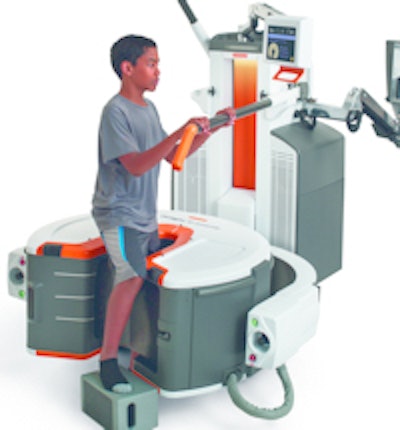
Carestream Health is teaming up with orthopedic and sports medicine specialists to develop a new 3D conebeam CT (CBCT) system to image extremities.
Carestream's CBCT scanner. Image courtesy of Carestream.Conebeam CT technology has been used to treat orthopedic conditions such as traumatic injuries, joint replacements, arthritis, and osteoporosis. It is also known to be cheaper and use less radiation than full-body CT scanners, Carestream said.
Carestream is targeting the new system for urgent care facilities and clinics, athletic training facilities, and orthopedist and other specialty practice offices. The company and its collaborators plan to conduct initial clinical studies using conebeam CT technology to diagnose and treat knee injuries.
Carestream made the announcement at this week's American Academy of Orthopaedic Surgeons (AAOS) conference. The system is not yet ready for clinical sale.






![Images show the pectoralis muscles of a healthy male individual who never smoked (age, 66 years; height, 178 cm; body mass index [BMI, calculated as weight in kilograms divided by height in meters squared], 28.4; number of cigarette pack-years, 0; forced expiratory volume in 1 second [FEV1], 97.6% predicted; FEV1: forced vital capacity [FVC] ratio, 0.71; pectoralis muscle area [PMA], 59.4 cm2; pectoralis muscle volume [PMV], 764 cm3) and a male individual with a smoking history and chronic obstructive pulmonary disorder (COPD) (age, 66 years; height, 178 cm; BMI, 27.5; number of cigarette pack-years, 43.2, FEV1, 48% predicted; FEV1:FVC, 0.56; PMA, 35 cm2; PMV, 480.8 cm3) from the Canadian Cohort Obstructive Lung Disease (i.e., CanCOLD) study. The CT image is shown in the axial plane. The PMV is automatically extracted using the developed deep learning model and overlayed onto the lungs for visual clarity.](https://img.auntminnie.com/mindful/smg/workspaces/default/uploads/2026/03/genkin.25LqljVF0y.jpg?auto=format%2Ccompress&crop=focalpoint&fit=crop&h=112&q=70&w=112)


