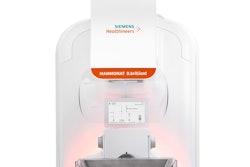
The U.S. Food and Drug Administration (FDA) has cleared Siemens Healthineers' Ciartic Move, a mobile C-arm with self-driving capabilities.
The company said the system standardizes 2D fluoroscopic and 3D cone-beam CT imaging for surgeons and operating room teams in hospitals and outpatient facilities. Ciartic Move is designed to address the needs of orthopedic, trauma, and spine surgery. It can be used in thoracic, vascular, cardiovascular, and general surgery, as well as urology and interventional pulmonology.
 Ciartic Move. Image courtesy of Siemens Healthineers.
The system is fully motorized from the C-arm down to its wheels, with self-driving capabilities to automate imaging workflows. Siemens said this reduces the time, effort, and workforce capacity needed to manually move and position the C-arm. Up to 12 procedure-specific positions can be stored along with related imaging parameters, the company added.
During a procedure, the stored positions and imaging parameters can be recalled at the touch of a button, without prolonged discussion between the surgeon and operating room team. This helps the surgeon and operating room staff reproduce images at the desired angle or return the C-arm to park and table positions.
Ciartic Move also features active sensing technology that protects against collision by scanning for obstacles while in transport mode and stopping all motorized movement if an obstacle is detected, according to the firm.