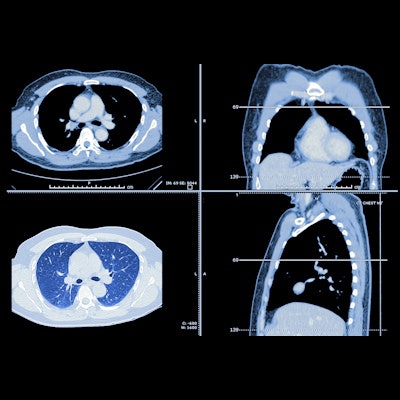
Dual-energy CT (DECT) performs comparably to perfusion CT for assessing angiogenesis of lesions resulting from solitary lung nodules, according to a study published January 4 in Scientific Reports.
The findings suggest that there's a lower radiation dose alternative to perfusion CT for evaluating lung tumors, wrote a team led by Dr. Arkadiusz Zegadło of the Military Institute of Medicine -- National Research Institute in Warsaw, Poland. Perfusion CT imparts a radiation dose 1.5 times higher than routine CT exams, while DECT imparts lower doses.
"[Using] a single DECT scan as an alternative to high-dose CTP for assessing solid lung lesion angiogenesis ... could be particularly beneficial for oncology patients, who often require multiple periodic follow-up CT scans," Zegadło's group wrote.
The investigators sought to compare the performance of DECT and perfusion CT via a study that included 28 patients with solitary pulmonary nodules. All patients had received both types of exams. The DECT exam conferred a radiation dose of 19.67 mGy compared with the 162.15 mGy imparted by the perfusion CT exam. Two radiologists assessed iodine concentration and normalized iodine concentration of the nodule from the DECT exam and perfusion measures such as blood flow, blood volume, time to maximum of the tissue residue function (Tmax), and permeability surface area product from the perfusion CT exam.
Zegadło and colleagues found good correlation between the two types of CT exams across the following measures (as assessed by Pearson R correlation, with 1 as reference):
- Iodine concentration and blood flow (0.78)
- Normalized iodine concentration and blood flow (0.71)
- Iodine concentration and blood volume (0.73)
- Normalized iodine concentration and blood volume (0.73)
Interreader agreement between perfusion CT and DECT was excellent, ranging from 0.96 to 0.99, they noted.
Although the investigators acknowledged the small sample size as a limitation to the study, they wrote that their results show DECT's promise as an alternative to perfusion CT for evaluating lung nodules.
"The results of our study highlighted the usefulness of DECT in the assessment of functional changes in the tumor vascular bed," they concluded. "Although it requires further studies, DECT examination could possibly replace CTP in the future in the functional assessment of oncological changes during early diagnosis and monitoring the effects of treatment, with comparatively lower exposure to the effects of radiation."