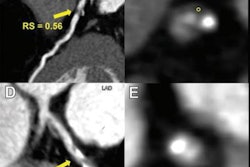
Using subtraction coronary CT angiography (CCTA) boosts diagnostic accuracy for coronary stenosis compared with conventional CCTA by reducing "blooming" artifacts caused by calcifications or stents, a team of Chinese researchers has found.
The findings could improve care for patients with high calcium loads as measured by Agatston scoring, wrote a group led by Dr. Jinhan Qiao of Huazhong University of Science and Technology in Wuhan, China. The results were published December 29 in Academic Radiology.
"Subtraction achieved better diagnostic accuracy in patients with Agatston score [equal to or higher than] than 400," the team noted.
CCTA is commonly used to diagnose coronary artery disease, but the "blooming effect" and beam-hardening artifacts can decrease diagnostic accuracy by actually overestimating the degree of stenosis, Qiao's group noted. That's why subtraction CCTA can help.
"The development of subtraction CCTA has been reported to be valuable for eliminating the artifacts by subtracting non-contrast images from contrast images, leaving the calcification or stents removed," the team wrote.
Qiao and colleagues sought to confirm whether subtraction CCTA could improve diagnosis of coronary stenosis via a study that included 180 patients with calcified heart plaque who underwent both CCTA and invasive coronary angiography (cardiac catheterization). Patients were categorized into three groups by Agatston score: A (low to moderate, or < 400, 86 patients); B (high, 400 to 999, 44 patients); and C (very high, ≥ 1000, 50 patients). The investigators used area under the receiving operating characteristic curve (AUC) to compare performance of conventional CCTA and subtraction CCTA.
Applying the subtraction technique to the CCTA exam improved diagnostic accuracy in patients with both 50% or more stenosis in groups B and C but not group A, the team found. This was also true for patients with 70% or more stenosis.
| Comparison of conventional CCTA and subtraction CCTA for identifying ≥ 50% coronary stenosis per patient | ||
| Conventional CCTA | Subtraction CCTA | |
| Group A | ||
| Accuracy | 80.2% | 82.6% |
| AUC | 0.83 | 0.81 |
| Sensitivity | 84.9% | 90.6% |
| Specificity | 72.7% | 69.7% |
| Group B | ||
| Accuracy | 86.4% | 97.7% |
| AUC | 0.81 | 0.93 |
| Sensitivity | 97.1% | 100% |
| Specificity | 44.4% | 88.9% |
| Group C | ||
| Accuracy | 96% | 96% |
| AUC | 0.64 | 0.95 |
| Sensitivity | 100% | 97.9% |
| Specificity | 33.3% | 66.7% |
The group also found that subtraction CCTA performed comparably to cardiac catheterization for assessing stenosis -- offering a less invasive alternative for the indication, the team noted.
The bottom line? Using subtraction CCTA improves diagnostic accuracy of coronary stenosis compared with conventional CCTA in patients with Agatston scores equal to or higher than 400, according to Qiao and colleagues.
"Our results showed decreased stenosis grading after subtraction in patients with [coronary artery calcium scores equal to or greater than] 400 compared with [conventional CCTA]," they concluded.