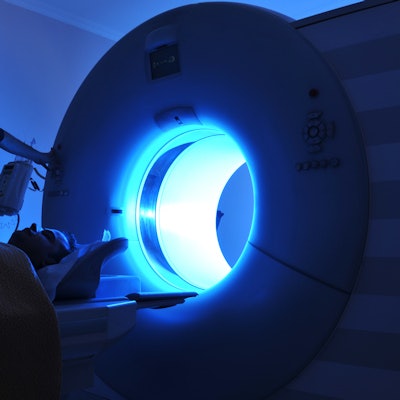
The American Association of Physicists in Medicine (AAPM) is celebrating 50 years of CT imaging October 1 by launching a new gallery in its AAPM Virtual Museum of Medical Physics and offering educational resources on the modality.
The gallery gives an overview of CT from 1963 to the present, outlining how the modality was developed and how it has influenced patient care. Additionally, John Boone, PhD, of the University of California, Davis and editor of AAPM's journal Medical Physics and Cynthia McCullough, PhD, AAPM fellow and director of the Mayo Clinic's CT Clinical Innovation Center in Rochester, MN, in September published a paper in the journal that recounts CT's history.
Medical physicists partner with radiologists and radiologic technologists on CT scans that use the lowest effective radiation and contrast doses possible, and regularly assess equipment to check that regulatory and accreditation requirements are met.
As for resources, in 2010 the AAPM helped establish the Alliance for Quality Computed Tomography, which supports quality CT scanning, the association said.

![Axial images from unenhanced calcium score cardiac CT (left) and curved planar reformation images from CT angiography (right) show that higher long-term exposure to air pollution is associated with greater coronary artery calcium and more obstructive coronary artery disease (CAD). Top row: Images in a 68-year-old male patient with higher 10-year mean ambient air pollution exposure (7.9 μg/m3 for particulate matter measuring ≤2.5 μm in diameter [PM2.5] and 17.4 parts per billion [ppb] for NO2) with extensive CAD (coronary artery calcium score [CACS] >1,000 and obstructive CAD [≥70% diameter stenosis]). Bottom row: Images in a 57-year-old female patient with lower 10-year mean ambient air pollution exposure (6.3 μg/m3 for PM2.5 and 4.6 ppb for NO2) with no CAD (CACS = 0 and no obstructive stenosis).](https://img.auntminnie.com/mindful/smg/workspaces/default/uploads/2026/06/hanneman.r6SMLzkezo.png?auto=format%2Ccompress&fit=crop&h=100&q=70&w=100)


![Axial images from unenhanced calcium score cardiac CT (left) and curved planar reformation images from CT angiography (right) show that higher long-term exposure to air pollution is associated with greater coronary artery calcium and more obstructive coronary artery disease (CAD). Top row: Images in a 68-year-old male patient with higher 10-year mean ambient air pollution exposure (7.9 μg/m3 for particulate matter measuring ≤2.5 μm in diameter [PM2.5] and 17.4 parts per billion [ppb] for NO2) with extensive CAD (coronary artery calcium score [CACS] >1,000 and obstructive CAD [≥70% diameter stenosis]). Bottom row: Images in a 57-year-old female patient with lower 10-year mean ambient air pollution exposure (6.3 μg/m3 for PM2.5 and 4.6 ppb for NO2) with no CAD (CACS = 0 and no obstructive stenosis).](https://img.auntminnie.com/mindful/smg/workspaces/default/uploads/2026/06/hanneman.r6SMLzkezo.png?auto=format%2Ccompress&fit=crop&h=112&q=70&w=112)