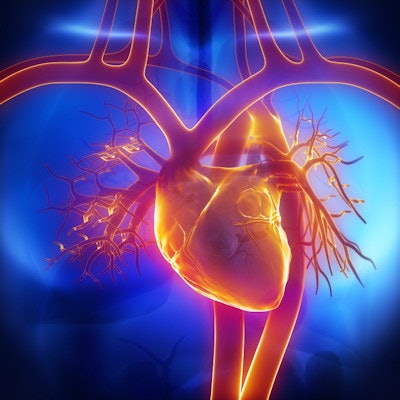
The use of cardiovascular CT and MRI has been increasing -- as has the number of radiologists providing these exams -- even though they still make up a fraction of the number of annual cardiac exams performed, according to a February 25 study in Radiology: Cardiothoracic Imaging.
The findings clarify cardiac imaging trends and could help set appropriate training protocols and reimbursement levels, wrote study co-authors James Goldfarb, PhD, and Jonathan Weber, both of St. Francis Hospital and Heart Center in Roslyn, NY.
"A clear understanding of the current state of cardiovascular MRI and CT in the United States would guide training recommendations and reimbursement and, in the future, affect clinical practice and use," they noted.
Enthusiasm for using cardiovascular CT and MRI for routine cardiac evaluation has increased, stoked by technical advances and positive clinical data, the authors wrote. But there has been little information about use trends and who actually performs these exams.
To address this knowledge gap, Goldfarb and Weber analyzed data taken from Medicare Part B physician payments from the Provider Utilization and Payment Data Physician and Other Supplier Public Use Files (POSPUF) between the years 2012 to 2017. They tracked number of providers and exams for cardiovascular MRI and CT, provider sex and location, and reimbursement.
Overall, the two found that use of cardiovascular CT and MRI increased over the study time period -- by 75.5% for MRI and by 97.4% for CT -- but remained a small portion of cardiac imaging, which continues to be dominated by echocardiography and nuclear medicine.
They also found the following:
- The number of providers performing cardiovascular imaging using these modalities increased: by 84.8% for cardiovascular MRI between 2012 and 2017 and by 77.3% for cardiovascular CT between 2012 and 2017.
- Most of these providers were men, and most were radiologists or cardiologists.
- Payments for cardiovascular MRI and CT exams over the time-period were $16.2 million and $55.8 million -- much lower than the $5.9 billion paid for echocardiography exams and $4.2 billion for nuclear cardiology tests.
Even though cardiovascular CT and MRI exams are a small segment of heart imaging, radiologists need to be prepared to offer them, wrote Dr. Andrew Bierhals of the Mallinckrodt Institute of Radiology in St. Louis in an accompanying editorial.
"We as radiologists need to understand what these data are telling us about the future of cardiac CT and MRI -- there will be continued growth, and radiologists will be expected to provide these services," he wrote. "How does this impact the radiology profession? First and foremost, there will need to be enough radiologists to ensure timely care as these services are increasingly being demanded by referring physicians. Second, radiologists, including those in general practice, will need understanding and training in cardiac CT and MRI."