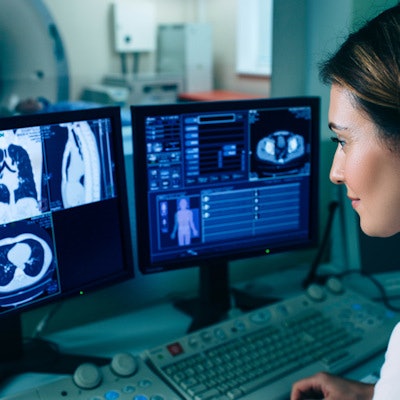
How radiologists perceive the image quality of CT scans is the subject of a new study led by researchers from the University of California, San Francisco (UCSF) and funded by the U.S. Centers for Medicare and Medicaid Services.
UCSF researchers are soliciting radiologists to participate by reviewing approximately 200 CT scans on an online portal, according to principal investigator Dr. Rebecca Smith-Bindman of UCSF. Survey participants will be asked for each case whether they believe image quality is adequate for diagnostic interpretation given the brief history that is provided. Radiologists will not be asked to provide a diagnosis.
The project will end in January 2020, and each participating radiologist will receive a $200 Amazon gift card. More information is available on the project's website.






![Images show the pectoralis muscles of a healthy male individual who never smoked (age, 66 years; height, 178 cm; body mass index [BMI, calculated as weight in kilograms divided by height in meters squared], 28.4; number of cigarette pack-years, 0; forced expiratory volume in 1 second [FEV1], 97.6% predicted; FEV1: forced vital capacity [FVC] ratio, 0.71; pectoralis muscle area [PMA], 59.4 cm2; pectoralis muscle volume [PMV], 764 cm3) and a male individual with a smoking history and chronic obstructive pulmonary disorder (COPD) (age, 66 years; height, 178 cm; BMI, 27.5; number of cigarette pack-years, 43.2, FEV1, 48% predicted; FEV1:FVC, 0.56; PMA, 35 cm2; PMV, 480.8 cm3) from the Canadian Cohort Obstructive Lung Disease (i.e., CanCOLD) study. The CT image is shown in the axial plane. The PMV is automatically extracted using the developed deep learning model and overlayed onto the lungs for visual clarity.](https://img.auntminnie.com/mindful/smg/workspaces/default/uploads/2026/03/genkin.25LqljVF0y.jpg?auto=format%2Ccompress&crop=focalpoint&fit=crop&h=112&q=70&w=112)

