Few patients who present to the emergency department with syncope or dizziness actually need a head CT scan, even though current medical practice pressures physicians to perform them, according to a new study in the American Journal of Roentgenology.
Fewer than 7.1% of patients coming to the emergency department with dizziness and 6.4% complaining of syncope or near-syncope benefited from the use of head CT, concluded researchers from Kaiser Foundation Hospital in Honolulu.
"If a careful history and physical examination do not find persistent neurologic signs, then a follow-up clinic visit the next day may be all that is necessary," said principal investigator Dr. Myles Mitsunaga in a statement.
The retrospective study looked at the electronic medical records of patients who presented to an HMO emergency department during the second half of 2012 and underwent a head CT for a primary complaint of dizziness, syncope, or near-syncope. The researchers looked for head CT scans with acutely abnormal findings and rates of hospital admission (AJR, January 2015, Vol. 204:1, pp. 24-28).
Of the 253 patients presenting with dizziness, 7.1% had head CT scans with acutely abnormal findings, and 18.6% were admitted to the hospital. Of the 236 patients who presented with syncope or near-syncope, 6.4% had head CT scans with acutely abnormal findings, and 39.8% were admitted.
Three clinical factors were found to correlate significantly with acutely abnormal head CT: having a focal neurologic deficit (p = 0.003), being older than 60 years (p = 0.011), and experiencing acute head trauma (p = 0.026), the authors wrote.
Unless the patients are older, have a focal neurologic deficit, or have a recent history of head trauma, CT is probably unnecessary, the study team concluded.

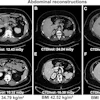
![Images show the pectoralis muscles of a healthy male individual who never smoked (age, 66 years; height, 178 cm; body mass index [BMI, calculated as weight in kilograms divided by height in meters squared], 28.4; number of cigarette pack-years, 0; forced expiratory volume in 1 second [FEV1], 97.6% predicted; FEV1: forced vital capacity [FVC] ratio, 0.71; pectoralis muscle area [PMA], 59.4 cm2; pectoralis muscle volume [PMV], 764 cm3) and a male individual with a smoking history and chronic obstructive pulmonary disorder (COPD) (age, 66 years; height, 178 cm; BMI, 27.5; number of cigarette pack-years, 43.2, FEV1, 48% predicted; FEV1:FVC, 0.56; PMA, 35 cm2; PMV, 480.8 cm3) from the Canadian Cohort Obstructive Lung Disease (i.e., CanCOLD) study. The CT image is shown in the axial plane. The PMV is automatically extracted using the developed deep learning model and overlayed onto the lungs for visual clarity.](https://img.auntminnie.com/mindful/smg/workspaces/default/uploads/2026/03/genkin.25LqljVF0y.jpg?auto=format%2Ccompress&crop=focalpoint&fit=crop&h=100&q=70&w=100)


![Images show the pectoralis muscles of a healthy male individual who never smoked (age, 66 years; height, 178 cm; body mass index [BMI, calculated as weight in kilograms divided by height in meters squared], 28.4; number of cigarette pack-years, 0; forced expiratory volume in 1 second [FEV1], 97.6% predicted; FEV1: forced vital capacity [FVC] ratio, 0.71; pectoralis muscle area [PMA], 59.4 cm2; pectoralis muscle volume [PMV], 764 cm3) and a male individual with a smoking history and chronic obstructive pulmonary disorder (COPD) (age, 66 years; height, 178 cm; BMI, 27.5; number of cigarette pack-years, 43.2, FEV1, 48% predicted; FEV1:FVC, 0.56; PMA, 35 cm2; PMV, 480.8 cm3) from the Canadian Cohort Obstructive Lung Disease (i.e., CanCOLD) study. The CT image is shown in the axial plane. The PMV is automatically extracted using the developed deep learning model and overlayed onto the lungs for visual clarity.](https://img.auntminnie.com/mindful/smg/workspaces/default/uploads/2026/03/genkin.25LqljVF0y.jpg?auto=format%2Ccompress&crop=focalpoint&fit=crop&h=112&q=70&w=112)