CHICAGO - At a press briefing at the RSNA 2011 show, researchers and violin makers showed how they used CT to examine a Stradivarius violin noninvasively and then recreate it using computer-controlled machinery.
Dr. Steve Sirr, a consultant radiologist at Abbott Northwestern Hospital in Minneapolis, and a pair of modern luthiers used CT to virtually dissect the renowned "Betts" Stradivarius violin, which was constructed in 1704.
"CT scanning offers a unique method of noninvasively imaging a historical object," Sirr said. "Combined with computer-aided machinery, it also offers us the opportunity to create a reproduction with a high degree of accuracy."
Sirr and luthiers John Waddle and Steve Rossow explained how the copy of the Betts violin was produced to match the original within fractions of a millimeter. They had a chance to scan the original violin recently at a tour in Oberlin, OH. The instrument is owned by the Library of Congress.
 |
| John Waddle, left, and Steve Rossow, sit behind their copy of the Betts Stradivarius. |
The researchers obtained more than 1,000 images of the Betts Stradivarius using a 64-detector-row CT scanner. The luthiers have made a few copies of the instrument, which are for sale by private treaty. Waddle said that when the reproduction -- sans finishing -- was played along with the Stradivarius, the instruments were said to sound remarkably similar.
The goal was to create instruments for young musicians who find that the world's finest violins are well out of their price range, he said.
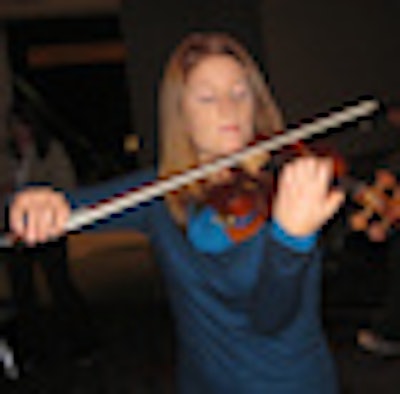
 Violinist Brigid McCarthy plays the Betts copy.
"We will see over time if using CT to produce these instruments is accepted," said Dr. Gary Whitman, professor of radiology at MD Anderson Cancer Center at the University of Texas, who moderated the press briefing. "You have to have people with very good expertise in the field evaluating it. It is using modern technology to replicate something that was handmade many years ago. It is using our current tools to try to find the old quality."
"We believe this process of recreating old and valuable stringed instruments may have a profound influence upon modern string musicians," Sirr said. "I assumed the instrument was merely a wooden shell surrounding air. I was totally wrong. There was a lot of anatomy inside the violin."
CT was helpful in measuring wood density, size and shapes, thickness graduation, and volume. "It also provides detailed analysis of damage and repair," he said.
Waddle and Rossow have used their computer-aided machinery and CT to produce 19 instruments, including six Stradivarius violins.
The reproduction of the Betts Stradivarius was demonstrated by professional violinist Brigid McCarthy of St. Paul, who played "Meditation" from "Thais," by Jules Massenet.
Editor's note: Watch a video of the presenters discussing how they use CT to scan and reproduce violins in the RADCast Image Gallery.