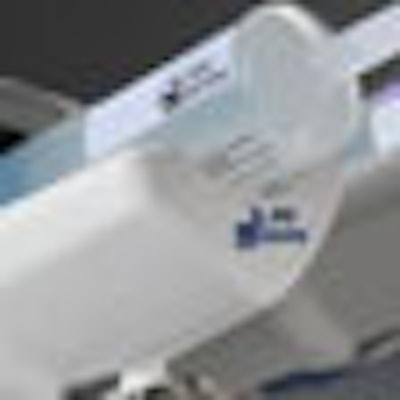
(Booth 9113) Covidien of Hazelwood, MO, will feature products from its Imaging Solutions business as it launches a new CT contrast delivery system that offers radiofrequency identification (RFID) technology.

The combined system is designed to help radiologic technologists deliver the prescribed concentration and programmed dose of contrast media during CT procedures. In addition, the approach indicates if an RFID-labeled syringe has been used, is empty, or has passed its expiration date. This safety capability is designed to reduce opportunities for life-threatening air injections or cross-contamination from more than one use of a given syringe. RFID transponders, or tags, provide the basis of the system.
The Optivantage equipment also facilitates documentation of the contrast used for the exam protocol by printing a label that can be placed into the patient record.




![Images show the pectoralis muscles of a healthy male individual who never smoked (age, 66 years; height, 178 cm; body mass index [BMI, calculated as weight in kilograms divided by height in meters squared], 28.4; number of cigarette pack-years, 0; forced expiratory volume in 1 second [FEV1], 97.6% predicted; FEV1: forced vital capacity [FVC] ratio, 0.71; pectoralis muscle area [PMA], 59.4 cm2; pectoralis muscle volume [PMV], 764 cm3) and a male individual with a smoking history and chronic obstructive pulmonary disorder (COPD) (age, 66 years; height, 178 cm; BMI, 27.5; number of cigarette pack-years, 43.2, FEV1, 48% predicted; FEV1:FVC, 0.56; PMA, 35 cm2; PMV, 480.8 cm3) from the Canadian Cohort Obstructive Lung Disease (i.e., CanCOLD) study. The CT image is shown in the axial plane. The PMV is automatically extracted using the developed deep learning model and overlayed onto the lungs for visual clarity.](https://img.auntminnie.com/mindful/smg/workspaces/default/uploads/2026/03/genkin.25LqljVF0y.jpg?auto=format%2Ccompress&crop=focalpoint&fit=crop&h=112&q=70&w=112)


