Dear AuntMinnie Member,
SAN FRANCISCO - When it comes to cutting-edge CT technologies, you've heard about dual-source, and most likely about 256-slice as well (at least, you have if you're an AuntMinnie.com member). But what about inverse-geometry CT (IGCT)?
This new technology is being examined as a way to scan large volumes, as thick as 15 cm or more, with a single gantry rotation. A group led by Stanford University researchers presented their work on IGCT to attendees at this week's International Symposium on Multidetector-Row CT, where staff writer Eric Barnes is on hand to report for our CT Digital Community.
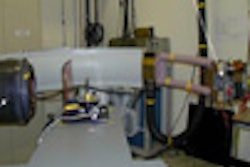
IGCT employs a large array of x-ray sources rather than a single point source, as is used in conventional CT. The array is combined with a smaller detector assembly, and both are rotated around the patient. The result is an image with no conebeam artifacts, isotropic pixels, very high spatial resolution, and good dose efficiency, the researchers say.
The drawback to IGCT? Well, at present it's still in the prototype phase, with only a tabletop model in operation. See for yourself whether IGCT represents the next phase in CT development by clicking here.
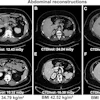
In another article from the conference, CT pioneer Willi Kalender discusses recent research on reducing radiation dose in pediatric CT studies by lowering x-ray tube voltage. His group measured radiation dose delivered to pediatric phantoms and found that reducing kV settings can produce good image quality with sharply lower dose.
In fact, he believes that kV could probably be reduced even lower than the settings possible with most commercially available CT scanners. Get the rest of the story by clicking here, and read more coverage from the MDCT conference by visiting our CT Digital Community, at ct.auntminnie.com.
In other news, we're pleased to be launching a new look for our PACS Digital Community. We think you'll find the new design fresher and easier to use, while you'll still continue to find all of our late-breaking content on digital image management -- including our coverage of last week's Society for Imaging Informatics in Medicine (SIIM) meeting. Check it out, at pacs.auntminnie.com.