Dear AuntMinnie Member,
Medical imaging is continually pushing the envelope of new technology. Nowhere have these efforts been more evident than in multislice CT, where each new generation of scanner technology collects an exponentially greater number of slices.
Now German researchers are offering a sneak peak at what could be CT's future, with a presentation from the European Congress of Radiology that we're featuring on AuntMinnieTV this week. Radiologists from the University of Aachen demonstrated phantom images collected with a scanner that used an amorphous silicon flat-panel detector rather than a traditional multislice CT array.
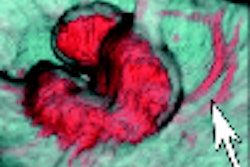
Because the flat-panel detector has a 1,024 x 768-pixel matrix, the system could be considered a 1,024-slice CT scanner. And as you can see by viewing the presentation below, it produces stunningly detailed images, especially of small structures like stents.
The group's work is still in the experimental phase; ultimately, flat-panel CT may not prove to be commercially or clinically viable. But their research highlights the spirit of innovation that is driving medical imaging to new heights.
Learn all about the experiment by clicking here. For the rest of our AuntMinnieTV clips, from both the RSNA and ECR conferences, click on the links below or go to our AuntMinnieTV home page at tv.auntminnie.com.