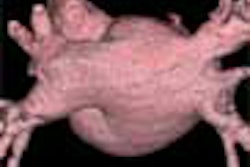
Multimodality vendor Toshiba America Medical Systems has unveiled a 64-slice CT scanner optimized for examination of the coronary arteries.
Aquilion 64 CFX features the firm's 64-row Quantum detector for simultaneous 64-slice scanning with a spatial resolution of 0.35 mm, volume imaging capabilities, and proprietary software applications designed to automate diagnostic cardiac studies, according to the Tustin, CA-based company.
The system is based on the 64-slice Aquilion platform, which Toshiba announced at the International Symposium on Multidetector-Row CT in June. An early unit has been scanning at the Fujita Health University in Japan since March 2004, and is currently performing clinical trials of its cardiac imaging capabilities. It will be available for delivery in 2005, the developer said.
Aquilion 64 is built on the same platform as the Aquilion 32 scanner, using the Quantum 64 detector, the company said. Aquilion 32 users can upgrade to an Aquilion 64 with a simple field modification, Toshiba said.
By AuntMinnie.com staff writersJuly 27, 2004
Related Reading
Toshiba announces 64-slice CT scanner, June 24, 2004
Toshiba releases new e.soft versions, June 22, 2004
Toshiba gets FDA nod for new flat-panel detector, May 26, 2004
Toshiba forges clinical research pact with Texas institute, May 20, 2004
Toshiba, Vital Images, Johns Hopkins to work on CTA apps, May 13, 2004
Copyright © 2004 AuntMinnie.com