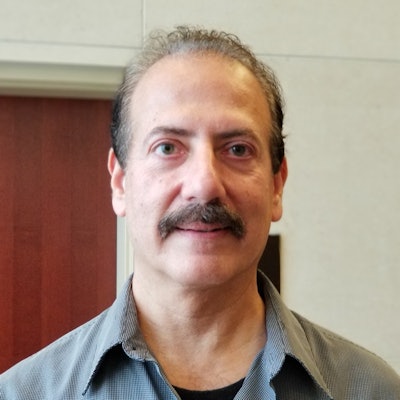
The COVID-19 pandemic has forced radiology to find new ways to deliver care. How can artificial intelligence (AI) help with the transition?
In this September 22 talk from AuntMinnie.com's 2020 Virtual Conference, Dr. Eliot Siegel of the University of Maryland discusses how AI gives radiology the opportunity to reinvent itself in an era of growing consolidation and remote practice.
Siegel is professor and vice chair of the department of diagnostic radiology at the University of Maryland School of Medicine, as well as chief of radiology and nuclear medicine for the Veterans Affairs Maryland Healthcare System.






![A normal mammogram confirmed by three-year radiologic follow-up illustrates reader-marked regions of interest (ROIs) during (A) unaided (round 1) and (B) artificial intelligence (AI)–assisted (round 2) reading. Each colored dot represents an ROI for recall by a human reader. Readers could mark more than one ROI per case, represented by multiple dots of the same color. During AI-assisted reading, the AI system displayed three visible prompts: two with suspicion of malignancy scores of 35% (left mediolateral oblique [L MLO] and craniocaudal [L CC]) and one with a suspicion of malignancy score of 10% (right craniocaudal [R CC]), shown as polygonal overlays. Without AI, six of 10 readers (60%) marked a false-positive ROI. With AI assistance, this fell to two of 10 (20%). R MLO = right mediolateral oblique.](https://img.auntminnie.com/mindful/smg/workspaces/default/uploads/2026/07/2026-07-14-radiology-mammogram-ai-auto-bias.H0bYO8QlWs.jpg?auto=format%2Ccompress&fit=crop&h=112&q=70&w=112)


