
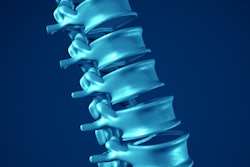
Artificial intelligence (AI) software developer Zebra Medical Vision has secured its fifth clearance from the U.S. Food and Drug Administration (FDA) for its software for analyzing vertebral compression fractures.
The clearance covers the application for identifying findings suggestive of compression fractures, which can help physicians develop treatment plans for patients at risk of osteoporosis, the company said. It is part of Zebra Medical Vision's AI1 line of software.
The software has already begun to be used outside the U.S. at Oxford University Hospital in the U.K. and St. Vincent's Hospital in Darlinghurst, Australia.








![A normal mammogram confirmed by three-year radiologic follow-up illustrates reader-marked regions of interest (ROIs) during (A) unaided (round 1) and (B) artificial intelligence (AI)–assisted (round 2) reading. Each colored dot represents an ROI for recall by a human reader. Readers could mark more than one ROI per case, represented by multiple dots of the same color. During AI-assisted reading, the AI system displayed three visible prompts: two with suspicion of malignancy scores of 35% (left mediolateral oblique [L MLO] and craniocaudal [L CC]) and one with a suspicion of malignancy score of 10% (right craniocaudal [R CC]), shown as polygonal overlays. Without AI, six of 10 readers (60%) marked a false-positive ROI. With AI assistance, this fell to two of 10 (20%). R MLO = right mediolateral oblique.](https://img.auntminnie.com/mindful/smg/workspaces/default/uploads/2026/07/2026-07-14-radiology-mammogram-ai-auto-bias.H0bYO8QlWs.jpg?auto=format%2Ccompress&fit=crop&h=112&q=70&w=112)


