AI's future in radiology depends on more than technological advancement—regulatory, financial, and cultural changes must align for meaningful impact. Radiologists must maintain deep technical understanding while preparing for rapid shifts in regulations, reimbursement policies, and patient expectations.
- AI capabilities advance rapidly, but regulatory change moves slowly while financial models can shift overnight based on reimbursement decisions
- AI has already impacted radiology outside the reading room through faster scanners and triage tools, though some lack financial viability despite good performance
- Patients are reshaping the landscape by accessing AI-generated summaries of imaging results and expecting transparency
- Radiologists must maintain deep knowledge of technology, pathology, and imaging physics because accountability depends on understanding
- The field should recognize its current era, prioritize human understanding, and communicate publicly about AI's role to counter misinformation
PHILADELPHIA -- Technology is only one of the forces shaping AI in radiology, and the field must prepare for a moment when technical, regulatory, financial, and cultural change all line up at once, according to a keynote given October 27 at the Society for Imaging Informatics (SIIM)-CAIMI meeting.
Nabile Safdar, MD, from Emory Healthcare in Atlanta, spoke on AI’s impact so far and cited events in scientific history and recent events in medicine to outline where AI could go in radiology.
Drawing on Madeleine L’Engle’s A Wrinkle in Time, Safdar argued that change moves at different speeds in different lanes. AI capabilities are advancing so quickly that “things I thought I knew two weeks ago, I’m not so sure about anymore,” he said. Regulatory change, by contrast, moves slowly, while financial models can shift overnight if CMS decides to pay for something.
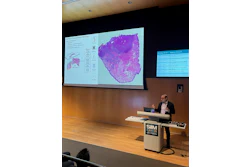
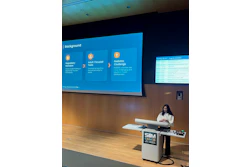
 Nabile Safdar, MD, gives his keynote lecture at the SIIM-CAIMI 2026 meeting in Philadelphia.
He pointed to history as a guide. Rocket pioneer Robert Goddard was ridiculed in 1920 in a New York Times article, with the paper not issuing a correction until 1969. Telehealth use jumped from under 1% to roughly 44% within weeks of the COVID-19 pandemic, though the technology had existed for years.
Safdar also cautioned that change is not always well-directed. Computer-aided detection, for example, was financially incentivized before its value was proven. And 83% of screening mammograms were read with CAD by 2012, a $400 million business.
AI’s impact so far
Revisiting the prediction made by Geoffrey Hinton, PhD, that radiologists would become obsolete, Safdar said the timing was off, but AI has already had an effect “around us more than with us,” largely outside the reading room. Faster scanners have improved access, but the bottleneck has simply moved upstream, he said. His own institution also found that some triage tools, despite good technical and clinical performance, did not make financial sense to keep.
Nabile Safdar, MD, outlines what's currently going well in medical imaging AI and what needs to be improved upon.
Patients, meanwhile, are changing the landscape. Under current law, they receive results as soon as they are signed and can generate AI summaries of them. Safdar said interactions with his health system’s portals climbed sharply after OpenAI launched ChatGPT Health.
He also noted that imaging no longer shares the AI spotlight alone. Ambient voice scribes and revenue cycle automation offer stronger returns right now, he said. Safdar cited one revenue cycle deployment with vendor projections above $20 million that is tracking near $17 million.
Existential questions
Safdar also spoke on harder questions for AI in radiology, including what the human role will be. He cited the recent reflections of mathematician Steven Strogatz, PhD, on AI in mathematics. Safdar noted that patients can already pay for a mammography-based breast cancer risk model whose creators admit they do not fully understand how it works.
Safdar gave an answer, saying that radiologists must keep deep knowledge of the technology, pathology, and imaging physics.
“The better the machine reads, the more understanding will actually matter,” he said. “Accountability is a derivative of understanding.”
Safdar shares his thoughts on the next big steps in regulation, accountability, and innovation in medical imaging AI.
Three asks
Safdar closed with three recommendations for the field: recognize which era it is in, whether institutions are moving slower or faster than its people; maintain human understanding even as machines grow more capable; and speak up publicly, rather than leaving the conversation to louder voices who “don’t know what they’re talking about.”
“Time folds,” he said. “We have to be in position regardless of which era we’re in.”
Check out AuntMinnie’s full coverage of CAIMI 2026 here.