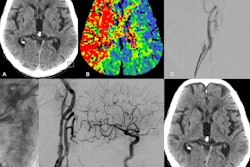
A major clinical trial found that mechanical thrombectomy selected using simple CT imaging alone produced significantly better functional outcomes and quality of life at one year compared to medical management alone in patients with large-core ischemic stroke, with more than three times as many thrombectomy patients achieving functional independence.
- The TESLA trial compared mechanical thrombectomy plus medical management to medical management alone in 302 patients with large anterior circulation strokes across 47 U.S. stroke centers.
- 23.6% of thrombectomy patients achieved functional independence (modified Rankin Scale 0-2) at one year versus only 6.8% of medical management patients, a more than threefold difference.
- The trial used noncontrast CT imaging alone for patient selection rather than advanced perfusion imaging, potentially broadening access to thrombectomy in lower-resource settings globally.
- Mean quality of life scores were significantly higher in the thrombectomy group (3.65 versus 2.78), with results consistent across multiple sensitivity analyses at the one-year follow-up.
- All-cause mortality showed no significant difference between groups (43.1% versus 46.6%), indicating thrombectomy safety profile comparable to medical management.
Mechanical thrombectomy produced significantly better functional outcomes and quality of life at one year than medical management alone in large-core ischemic stroke, according to a study published August 3 in JAMA.
A group from Bon Secours Mercy Health Neuroscience Institute in Toledo, Ohio, evaluated secondary outcomes of the TESLA (Thrombectomy for Emergent Salvage of Large Anterior Circulation Ischemic Stroke) trial, which did not meet its preplanned primary endpoint of statistical superiority at 90 days, noted lead author Osama Zaidat, MD, and colleagues.
“Because recovery or decline after large-core stroke may extend beyond 90 days, this article presents the prespecified one-year secondary efficacy and safety outcomes,” the group wrote.
Prior large-core stroke trials have demonstrated 90-day thrombectomy benefits but relied on advanced multimodal perfusion imaging for patient selection, limiting access in lower-resource settings, the authors explained. Notably, the TESLA trial used a noncontrast CT (NCCT)-alone patient selection protocol, which could offer a potential alternative that could broaden access to mechanical thrombectomy globally, they noted.
In the trial, 302 patients with large anterior circulation infarcts and an Alberta Stroke Program Early CT Score (ASPECTS) of 2 to 5 on baseline NCCT underwent either intra-arterial thrombectomy (IAT) plus best medical management (MM) or MM alone across 47 U.S. stroke centers. Complete one-year data were available for 144 IAT and 133 MM patients. The primary one-year endpoint was mean utility-weighted modified Rankin Scale (mRS) score (range, 0 to 10, with higher scores indicating preferable functional states).
According to the analysis, the mean utility-weighted mRS score was 3.65 in the IAT group and 2.78 in the MM group, a Bayesian adjusted mean difference of 1.18 points, with results consistent across multiple sensitivity analyses.
In secondary results, 23.6% of IAT patients achieved functional independence (mRS 0-2) versus 6.8% of MM patients (risk difference, 16.8%; p < 0.001), a more than threefold difference, the researchers reported. Independent ambulation (mRS 0-3) occurred in 35.4% versus 18.0% (p < 0.001), while all-cause mortality was 43.1% versus 46.6%, a difference that did not reach statistical significance.
“This extended follow-up of the TESLA trial demonstrated that mechanical thrombectomy for large anterior circulation infarcts selected by NCCT resulted in improved functional outcomes and higher patient-reported quality of life at one year compared with MM alone,” the group wrote.
External validity to lower-resource regions remains unestablished given that the trial occurred within highly optimized U.S. stroke networks, the group noted, adding that the NCCT-alone selection paradigm warrants further study as a lower barrier strategy for global stroke systems.
Read the full study here.