The founder of Israeli digital x-ray developer Nanox, Ran Poliakine, will relinquish his role as CEO in January 2022, the company announced with the release of second-quarter financial results.
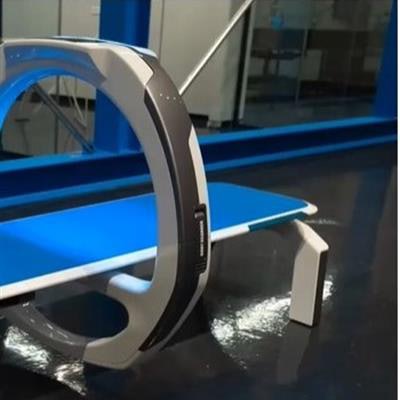
Poliakine founded Nanox with the goal of bringing to market a low-cost, highly functional digital x-ray system called Nanox.CART that could be deployed globally. A version of Nanox.CART with a single x-ray source has already been cleared by the U.S. Food and Drug Administration; the company is also developing a multiple-source version of the system.
Nanox this week announced that it was planning to acquire artificial intelligence software developer Zebra Medical Vision, as well as teleradiology service provider USARad Holdings. The deals will enable Nanox to offer a totally integrated end-to-end solution for radiology services in which the company's digital x-ray scans could be interpreted by both artificial intelligence software and teleradiology specialists, according to the company.
With those deals done, Poliakine said he has decided to turn over the CEO job to Erez Meltzer, a member of the company's board of directors, effective January 2022. Poliakine will continue to focus on long-term vision for the company as executive chairman.
In other personnel news, Ran Daniel was named chief financial officer, replacing Itzhak Maayan, who helped Nanox complete its initial public offering in 2020.
Finally, Nanox reported financial results for its second quarter of 2020 (end-June 30). The company posted a net loss of $13.6 million, compared with a net loss of $6.4 million for the same period the year before. Nanox ended the quarter with net cash and cash equivalents of $193.4 million.


![Representative example of a 16-year-old male patient with underlying X-linked adrenoleukodystrophy. (A, B) Paired anteroposterior (AP) chest radiograph and dual-energy x-ray absorptiometry (DXA) report shows lumbar spine (L1 through L4) areal bone mineral density (BMD). The DXA report was reformatted for anonymization and improved readability. The patient had low BMD (Z score ≤ −2.0). (C) Model (chest radiography [CXR]–BMD) output shows the predicted raw BMD and Z score in comparison with the DXA reference standard, together with interpretability analyses using Shapley additive explanations (SHAP) and gradient-weighted class activation maps. The patient was classified as having low BMD, consistent with the reference standard. AM = age-matched, DEXA = dual-energy x-ray absorptiometry, RM2 = room 2, SNUH = Seoul National University Hospital, YA = young adult.](https://img.auntminnie.com/mindful/smg/workspaces/default/uploads/2026/04/ai-children-bone-density.0snnf2EJjr.jpg?auto=format%2Ccompress&fit=crop&h=100&q=70&w=100)


![Representative example of a 16-year-old male patient with underlying X-linked adrenoleukodystrophy. (A, B) Paired anteroposterior (AP) chest radiograph and dual-energy x-ray absorptiometry (DXA) report shows lumbar spine (L1 through L4) areal bone mineral density (BMD). The DXA report was reformatted for anonymization and improved readability. The patient had low BMD (Z score ≤ −2.0). (C) Model (chest radiography [CXR]–BMD) output shows the predicted raw BMD and Z score in comparison with the DXA reference standard, together with interpretability analyses using Shapley additive explanations (SHAP) and gradient-weighted class activation maps. The patient was classified as having low BMD, consistent with the reference standard. AM = age-matched, DEXA = dual-energy x-ray absorptiometry, RM2 = room 2, SNUH = Seoul National University Hospital, YA = young adult.](https://img.auntminnie.com/mindful/smg/workspaces/default/uploads/2026/04/ai-children-bone-density.0snnf2EJjr.jpg?auto=format%2Ccompress&fit=crop&h=112&q=70&w=112)