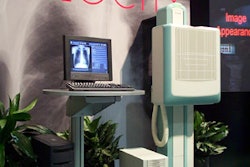
Toshiba America Medical Systems is showcasing its Ultimax multipurpose x-ray system at this week's meeting of the Society of Interventional Radiology in Salt Lake City.
The system's work-in-progress DynaDirect detectors employ Toshiba's Dynamic Direct Conversion technique to convert incident x-rays to digital signals directly, rather than first converting the x-rays to light, according to the Tustin, CA-based vendor.
The DynaDirect detectors yield a 150-micron pixel size and feature a 14 x 14-inch square panel. The detectors will be available as a field upgrade package, requiring the exchange of only a few critical components, Toshiba said.
By AuntMinnie.com staff writersMarch 28, 2003
Related Reading
Short-bore MRI scanner leads Toshiba RSNA highlights, December 5, 2002
Copyright © 2003 AuntMinnie.com







![Representative example of a 16-year-old male patient with underlying X-linked adrenoleukodystrophy. (A, B) Paired anteroposterior (AP) chest radiograph and dual-energy x-ray absorptiometry (DXA) report shows lumbar spine (L1 through L4) areal bone mineral density (BMD). The DXA report was reformatted for anonymization and improved readability. The patient had low BMD (Z score ≤ −2.0). (C) Model (chest radiography [CXR]–BMD) output shows the predicted raw BMD and Z score in comparison with the DXA reference standard, together with interpretability analyses using Shapley additive explanations (SHAP) and gradient-weighted class activation maps. The patient was classified as having low BMD, consistent with the reference standard. AM = age-matched, DEXA = dual-energy x-ray absorptiometry, RM2 = room 2, SNUH = Seoul National University Hospital, YA = young adult.](https://img.auntminnie.com/mindful/smg/workspaces/default/uploads/2026/04/ai-children-bone-density.0snnf2EJjr.jpg?auto=format%2Ccompress&fit=crop&h=112&q=70&w=112)


