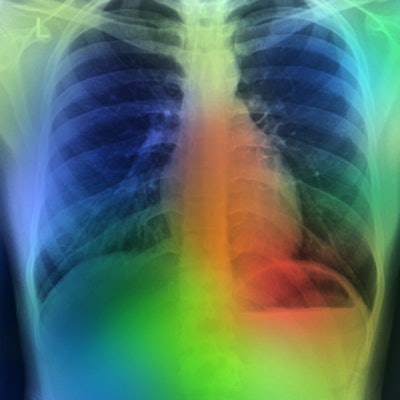
Artificial intelligence (AI) software developer Riverain Technologies is unveiling enhancements to its ClearRead AI platform for lung nodule detection at the RSNA 2021 meeting in Chicago.
Workflow enhancements improve the clinical user experience through tighter integration, the firm said. For instance, Fleischner and Lung-RADS scores can be customized to institutional or provider preferences and included in the case-level summary report. Also, lung nodules can be sorted based on diameter, mass, volume, doubling time, and more. Plus, standardized reports have been changed for configurability, language, and readability with a configurable PDF output.
Riverain also upgraded ClearRead's nodule detection so that it shows improved performance on mediastinal nodules, nodule typing, and nodule matching. Finally, the firm has also updated its system service capabilities.







![Axial images from unenhanced calcium score cardiac CT (left) and curved planar reformation images from CT angiography (right) show that higher long-term exposure to air pollution is associated with greater coronary artery calcium and more obstructive coronary artery disease (CAD). Top row: Images in a 68-year-old male patient with higher 10-year mean ambient air pollution exposure (7.9 μg/m3 for particulate matter measuring ≤2.5 μm in diameter [PM2.5] and 17.4 parts per billion [ppb] for NO2) with extensive CAD (coronary artery calcium score [CACS] >1,000 and obstructive CAD [≥70% diameter stenosis]). Bottom row: Images in a 57-year-old female patient with lower 10-year mean ambient air pollution exposure (6.3 μg/m3 for PM2.5 and 4.6 ppb for NO2) with no CAD (CACS = 0 and no obstructive stenosis).](https://img.auntminnie.com/mindful/smg/workspaces/default/uploads/2026/06/hanneman.r6SMLzkezo.png?auto=format%2Ccompress&fit=crop&h=112&q=70&w=112)


