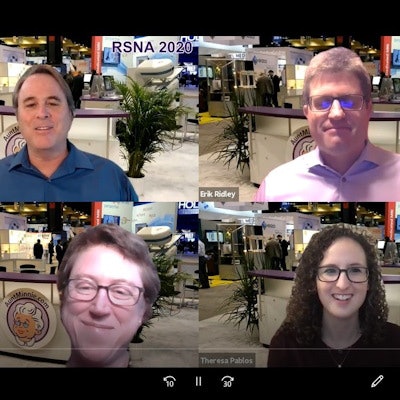
What have been the top stories at this week's RSNA 2020 virtual conference? Artificial intelligence (AI), imaging of COVID-19, and breast MRI have drawn attention, according to this roundup from day 2 of the meeting, provided by AuntMinnie.com's editorial team.
While the human interaction of the in-person RSNA conference is missing this year, the virtual format does have some advantages, according to our team. And the high quality of the RSNA program remains, even in this pandemic year.
AuntMinnie.com's comprehensive coverage of RSNA 2020 is available in the RADCast@RSNA special section, at rsna.auntminnie.com.





![Axial images from unenhanced calcium score cardiac CT (left) and curved planar reformation images from CT angiography (right) show that higher long-term exposure to air pollution is associated with greater coronary artery calcium and more obstructive coronary artery disease (CAD). Top row: Images in a 68-year-old male patient with higher 10-year mean ambient air pollution exposure (7.9 μg/m3 for particulate matter measuring ≤2.5 μm in diameter [PM2.5] and 17.4 parts per billion [ppb] for NO2) with extensive CAD (coronary artery calcium score [CACS] >1,000 and obstructive CAD [≥70% diameter stenosis]). Bottom row: Images in a 57-year-old female patient with lower 10-year mean ambient air pollution exposure (6.3 μg/m3 for PM2.5 and 4.6 ppb for NO2) with no CAD (CACS = 0 and no obstructive stenosis).](https://img.auntminnie.com/mindful/smg/workspaces/default/uploads/2026/06/hanneman.r6SMLzkezo.png?auto=format%2Ccompress&fit=crop&h=112&q=70&w=112)
