More than 20% of U.S. military veterans who had a negative baseline CT lung cancer screening exam did not return for their follow-up exam, according to a study presented at the 2018 American College of Chest Physicians (CHEST) meeting in San Antonio.
In the retrospective study, researchers from the Medical University of South Carolina (MUSC) reviewed the adherence rate of individuals who underwent CT lung screening at one of eight hospitals involved in the Veterans Health Administration Lung Cancer Screening Demonstration Project from July 2013 to June 2015. Screening participants were current and former smokers between 55 and 80 years old with a smoking history of at least 30 pack-years.
Among all veterans who underwent baseline CT exams, 60% had negative scans for lung cancer and were scheduled for follow-up exams within 15 months. Of the 1,120 individuals eligible for repeat screening tests, only 880 (77.6%) showed up for the exams.
"Even within the context of a well-designed, implemented, and guideline-adherent [CT lung cancer] screening program, adherence is not optimal and does not reach the reported 95% of the [National Lung Screening Trial] when the baseline scan is negative," lead investigator Dr. Paul Brasher said in a statement from CHEST. "Both mortality benefit and cost-efficacy are likely to suffer without better adherence."



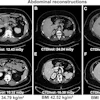
![Axial images from unenhanced calcium score cardiac CT (left) and curved planar reformation images from CT angiography (right) show that higher long-term exposure to air pollution is associated with greater coronary artery calcium and more obstructive coronary artery disease (CAD). Top row: Images in a 68-year-old male patient with higher 10-year mean ambient air pollution exposure (7.9 μg/m3 for particulate matter measuring ≤2.5 μm in diameter [PM2.5] and 17.4 parts per billion [ppb] for NO2) with extensive CAD (coronary artery calcium score [CACS] >1,000 and obstructive CAD [≥70% diameter stenosis]). Bottom row: Images in a 57-year-old female patient with lower 10-year mean ambient air pollution exposure (6.3 μg/m3 for PM2.5 and 4.6 ppb for NO2) with no CAD (CACS = 0 and no obstructive stenosis).](https://img.auntminnie.com/mindful/smg/workspaces/default/uploads/2026/06/hanneman.r6SMLzkezo.png?auto=format%2Ccompress&fit=crop&h=100&q=70&w=100)


![Axial images from unenhanced calcium score cardiac CT (left) and curved planar reformation images from CT angiography (right) show that higher long-term exposure to air pollution is associated with greater coronary artery calcium and more obstructive coronary artery disease (CAD). Top row: Images in a 68-year-old male patient with higher 10-year mean ambient air pollution exposure (7.9 μg/m3 for particulate matter measuring ≤2.5 μm in diameter [PM2.5] and 17.4 parts per billion [ppb] for NO2) with extensive CAD (coronary artery calcium score [CACS] >1,000 and obstructive CAD [≥70% diameter stenosis]). Bottom row: Images in a 57-year-old female patient with lower 10-year mean ambient air pollution exposure (6.3 μg/m3 for PM2.5 and 4.6 ppb for NO2) with no CAD (CACS = 0 and no obstructive stenosis).](https://img.auntminnie.com/mindful/smg/workspaces/default/uploads/2026/06/hanneman.r6SMLzkezo.png?auto=format%2Ccompress&fit=crop&h=112&q=70&w=112)