Tuesday, December 1 | 11:20 a.m.-11:30 a.m. | SSG05-06 | Room E352
How low can the CT radiation dose go for hepatic metastasis detection when using advanced iterative reconstruction? Investigators from the Mayo Clinic in Rochester, MN, wanted to see how low advanced iterative reconstruction would take them."The trade-offs between observer performance and radiation dose are largely unknown for some of the most common diagnostic tasks in CT imaging," lead author Dr. Joel Fletcher told AuntMinnie.com. "Most radiologists agree that current dose levels are safe and result in substantial patient benefit, but there is a great desire to reduce radiation dose further without compromising diagnostic benefit."
The researchers sought to estimate the ability of abdominal radiologists to detect hepatic metastases over a wide range of dose levels, both with and without iterative reconstruction, to determine lower dose levels where performance is not preserved.
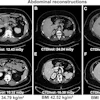
For the study, 12 histologically proven hepatic metastasis datasets were reconstructed with either filtered back projection or sonogram-affirmed iterative reconstruction. Three readers randomly evaluated the data, circling lesions and providing a diagnosis and confidence score.
The lower-dose CT images reconstructed at dose levels corresponding to 120 and 160 quality reference mAs performed similarly to 200 quality reference mAs in the pilot study. The results suggest that substantial dose reduction is possible in this setting without compromising performance.