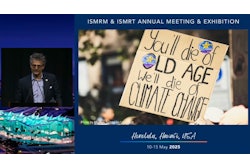
Two long-time leaders in U.S. radiology are encouraging the field to embrace a “bedside to biosphere” concept for advancing sustainability research and suggest an effective framework is already in place.
In an interview with AuntMinnie.com, Reed Omary, MD, of Vanderbilt University in Nashville, TN, explained the concept and noted that radiology can lead sustainability research the same way it helped lead medicine’s digital transformation.
Omary and colleague Thomas Grist, of the University of Wisconsin-Madison in Madison, WI, penned a recent article outlining the concept in the American Journal of Roentgenology, titled “The Translational Medicine of 2030: Bedside to Biosphere.”
The pair noted that collaborating with industry partners is one path, yet that entirely new low-carbon imaging techniques could be developed further back in the pipeline, with validation studies measuring planetary outcomes alongside patient outcomes.
Grist explained that the Fryback and Thornbury hierarchical model, which was published in 1991 and has since become a worldwide standard for assessing new medical technologies, could be applied in these new efforts.
Why is 2030 the target goal to see the concept in play? Omary noted that is the date established by the 2015 Paris Agreement treaty to limit global warming and that aligning the “bedside to biosphere” concept with such initiatives will allow radiology researchers to begin to measure their progress.
Omary, who also writes a blog on sustainability in health care, served as Vanderbilt’s chair of radiology from 2012 to 2023; Grist served as chair of radiology at the University of Wisconsin School of Medicine and Public Health from 2005 to 2023.