Asking personal assistants like Alexa about complex health issues isn't a reality now, but one day it might be. Researchers describe how an interactive health educator called Danya could teach women about breast density in a study published in the Journal of General Internal Medicine on January 9.
More than three-quarters of U.S. states now have breast density notification laws, but new research shows these laws may not make women more aware of the risks associated with having dense breasts. An interactive prototype like the one described in the study could help personalize breast density education.
"There's a lot of complex information, and the medical system doesn't always do the best job of explaining things or can't answer questions quickly if you aren't in a doctor's office," stated lead study author Christine Gunn, PhD, an assistant professor at the Boston University School of Medicine, in a press release. "We hope tools like our virtual health counselor can support women, no matter where they are, understand their own health, and empower them to get the right care when they need it."
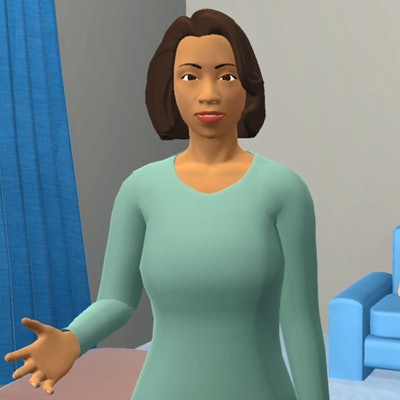
To create the prototype, the researchers partnered with an organization of black women who were breast cancer survivors. Black women and minorities are more likely to have dense breasts yet less likely to know their density status. Together, they built Danya, a virtual health educator.
The researchers tested a three-minute video sample of Danya presenting breast information with 44 women eligible for mammography screening between the ages of 40 and 74. The women were primarily black and had a variety of education levels.
 Danya prototype. Image courtesy of Boston University School of Medicine.
About two-thirds of participants said they were satisfied with Danya. The majority reported that she was easy to understand (75%), and they were confident she could help them (64%).
Many liked that they could ask Danya questions without judgment, although about half of the women said they would still rather talk to a doctor or a nurse. Some women had concerns over data sharing and privacy, while others wanted to ensure their physician and care team had timely access to the information.

In survey results, the women's knowledge about breast density significantly increased in many areas after just the three-minute Danya demonstration. The women were far more likely to know about breast density's link to cancer and difficulty reading mammograms.
"The flexibility of the computer-animated agent's approach fits with data suggesting that personal relevance, context, and readiness are important considerations in learning new health concepts," the authors wrote.
It is important to note the study had a small sample size, and the researchers weren't able to test the interactive elements of the prototype. Nevertheless, personalized learning counselors, like Danya, may be the future for teaching patients about breast density and other health topics.
"Interactive, smartphone-based education can add to [breast density notification] letters making medical information easier to understand," Gunn stated. "The public should know about the different evidence-based material that may be offered to help them understand complex health issues, like breast density."