A roasted version of barley can illuminate the throat and gastrointestinal tract when lit with a laser beam, acting as a natural contrast agent, according to research published in the journal Biomaterials.
The findings suggest that barley could serve as an alternative to barium for imaging dysphagia, or swallowing disorders, said study co-author Jun Xia, PhD, of the State University of New York at Buffalo (Biomaterials, August 2018, Vol. 175, pp. 72-81).
"Here you have this common grain -- it has been grown all over the world for thousands of years, and used to make tea, bread, beer -- and we're just now finding another use for it as a contrast agent for medical imaging," Xia said in a statement released by the university.
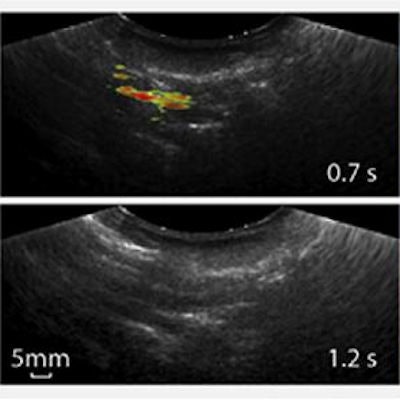
 Images show roasted barley as a subject swallows it over the course of 1.2 seconds. Courtesy of the University of New York at Buffalo.
Physicians typically test for dysphagia by having patients drink barium before undergoing x-ray, MRI, or ultrasound exams to image the throat. Photoacoustic CT (PACT) has emerged as an alternative to these modalities, but it still requires the use of a contrast agent.
Xia and colleagues explored whether there might be edible alternatives to contrast for PACT imaging. The group was able to detect individual particles of roasted barley through 3.5 cm of chicken breast tissue, as well as through human hands. Roasted barley tea was identifiable through 2.5 cm of chicken tissue, and it also visualized the throat in human subjects while they were swallowing, the researchers found.