A Johns Hopkins study found that long-term exposure to traffic-related air pollution, particularly nitrogen dioxide, is linked to faster bone loss in the spine of older adults, with effects more pronounced in men and potentially detectable through routine chest CT scans.
- Researchers analyzed CT scans from 1,320 older adults over 6.3 years and found higher nitrogen dioxide exposure corresponded to 1.6% faster spine bone density decline per year
- The effect was concentrated in men, showing decline of 0.80 mg/cm³/year versus 0.12 mg/cm³/year in women
- Spine bone loss weakens vertebrae and increases fracture risk, leading to chronic pain, height loss, and spinal deformity
- Recent air pollution exposure (within one year) showed the clearest link to bone loss, suggesting bone remodeling cycles play a role
- Opportunistic bone density measurements on routine chest scans could help identify adults at environmental risk for accelerated skeletal decline
Chest CT scans reveal that long-term exposure to traffic-related air pollution is linked to faster vertebral bone loss in older adults, according to a study to be presented December 1 at the RSNA meeting.
A group from Johns Hopkins University School of Medicine analyzed CT-derived vertebral bone data from the Multi-Ethnic Study of Atherosclerosis (MESA), with findings suggesting that opportunistic bone density measurement on routine chest scans could flag adults at environmental risk for accelerated skeletal decline, noted lead author Sara Momtazmanesh, MD, and colleagues.
“Air pollution may affect bone as well as the heart and lungs,” Momtazmanesh said in an RSNA statement. “In our study, higher recent exposure to nitrogen dioxide was linked to modestly faster loss of spine bone density.”
Loss of vertebral bone mineral density (BMD) weakens the spine and raises fracture risk, with consequences including chronic pain, height loss, and spinal deformity, the group explained.
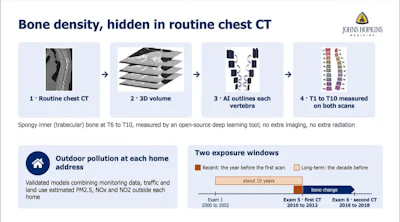
To assess air pollution’s association with longitudinal vertebral bone loss, the researchers enrolled 1,320 older adults (mean age, 69.3 years old; 52% women) from six U.S. metropolitan sites who underwent noncontrast chest CT at two timepoints approximately 6.3 years apart (2010–2012 and 2016–2018). Trabecular vertebral BMD (vBMD) at thoracic levels T6–T10 was quantified using a validated deep learning pipeline (TotalSegmentator v2/nnU-Net) with phantom-calibrated conversion. Cumulative exposures to PM2.5, nitrogen oxides (NOx), and black carbon were estimated from residence-based spatiotemporal models.
According to the results, per interquartile-range increment, cumulative NOx corresponded to an additional –0.45 mg/cm³ per year of vBMD decline, approximately 1.6% of baseline over the follow-up period, and black carbon to –0.40 mg/cm³ per year. PM2.5 showed no significant association. The NOx effect was concentrated in men (–0.80 mg/cm³/year versus –0.12 mg/cm³/year in women; p = .02) and was null in participants already taking antiresorptive medications at baseline, the researchers reported.
"The clearest link was with nitrogen dioxide exposure in the year before the first scan, and it was less consistent for exposure averaged over the preceding decade. That fits with how bone renews itself, in remodeling cycles of about seven months, but it could also reflect less precise long-term estimates," Momtazmanesh said.
Further research is needed to determine whether the association between air pollution and bone loss is temporary, cumulative or persistent over many years, the group concluded.
Momtazmanesh will present the work on Tuesday, December 1 at 12:15 p.m. in a musculoskeletal imaging poster discussions session in the Learning Center.
Check out AuntMinnie’s full coverage of RSNA 2026 on our conference page.