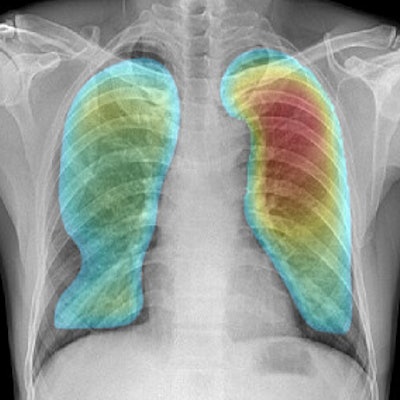
Artificial intelligence (AI) algorithm developer JLK Inspection has signed an agreement with the Clinton Health Initiative and the National Tuberculosis Center to expand access to tuberculosis (TB) screenings in Laos.
JLK's AI-based lung disease analysis algorithm JLD-02K allows doctors to make tuberculosis diagnoses more effectively. The software aims to address the problem of low radiologist capacity while also reducing screening expenses.


JLD-OK is an AI-enabled lung disease analysis software. Image courtesy of JLK Inspection.
JLD-02K doesn't have to run on a high-end workstation and can instead be used on mini personal computers or laptops, according to the company.
The groups selected JLK in December 2019, and they began using the algorithm on February 20.






![A normal mammogram confirmed by three-year radiologic follow-up illustrates reader-marked regions of interest (ROIs) during (A) unaided (round 1) and (B) artificial intelligence (AI)–assisted (round 2) reading. Each colored dot represents an ROI for recall by a human reader. Readers could mark more than one ROI per case, represented by multiple dots of the same color. During AI-assisted reading, the AI system displayed three visible prompts: two with suspicion of malignancy scores of 35% (left mediolateral oblique [L MLO] and craniocaudal [L CC]) and one with a suspicion of malignancy score of 10% (right craniocaudal [R CC]), shown as polygonal overlays. Without AI, six of 10 readers (60%) marked a false-positive ROI. With AI assistance, this fell to two of 10 (20%). R MLO = right mediolateral oblique.](https://img.auntminnie.com/mindful/smg/workspaces/default/uploads/2026/07/2026-07-14-radiology-mammogram-ai-auto-bias.H0bYO8QlWs.jpg?auto=format%2Ccompress&fit=crop&h=112&q=70&w=112)


