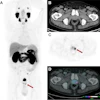
A new study shows that Ga-68 FAPI-04 PET imaging is significantly better than contrast-enhanced CT for detecting peritoneal carcinomatosis in ovarian cancer patients, achieving 82% sensitivity compared to 55% for CT, which helps doctors better plan surgery and guide treatment decisions.
- FAPI-PET achieved 82% sensitivity and 86% accuracy compared to 55% sensitivity and 78% accuracy for contrast-enhanced CT in detecting peritoneal carcinomatosis
- Superior performance in surgically challenging regions: upper abdomen sensitivity reached 77% for FAPI-PET versus 24% for CT
- Study included 200 women with histologically confirmed epithelial ovarian cancer who underwent both Ga-68 FAPI-04 PET/CT and contrast-enhanced CT before surgery
- Peritoneal carcinomatosis occurs in over 70% of ovarian cancer cases at diagnosis, making accurate preoperative assessment critical for treatment planning
- FAPI-PET offers noninvasive imaging independent from glucose metabolism, supporting its incorporation into routine preoperative evaluation
Fibroblast activation protein inhibitor (FAPI) PET appears superior to contrast-enhanced CT for detecting peritoneal carcinomatosis in patients with ovarian cancer, according to a study published August 27 in the Journal of Nuclear Medicine.
A group from the Aster International Institute of Oncology in Bangalore, India, compared the two modalities in patients before surgery, with findings suggesting gallium-68 (Ga-68) FAPI-04 PET/CT can more accurately map peritoneal tumor burden to guide surgical planning and treatment, noted lead author Somashekhar SP, MD, and colleagues.
"FAPI-PET significantly outperformed [contrast-enhanced] CT in diagnostic sensitivity and [Peritoneal Cancer Index] estimation, particularly in surgically challenging regions, such as the small bowel and upper abdomen," the group wrote.
Peritoneal carcinomatosis in ovarian cancer is cancer that has spread from the ovaries to the peritoneum, which is the lining of the belly and abdominal organs. The condition is present in more than 70% of ovarian cancer cases at diagnosis, with accurate preoperative assessment critical for deciding between primary cytoreductive surgery and neoadjuvant chemotherapy, the authors noted.
While conventional contrast-enhanced CT is widely used to stage patients, FAPI-PET has shown promise in early studies. In this study, the researchers aimed to boost evidence on its effectiveness.
The group enrolled 200 women with histologically confirmed epithelial ovarian cancer and suspected peritoneal carcinomatosis. All patients underwent whole-body Ga-68 FAPI-04 PET/CT alongside dedicated abdominopelvic contrast-enhanced CT before surgery over a 12-month period. Disease burden was quantified using the Peritoneal Cancer Index (PCI), a reproducible scoring tool grading tumor volume across 13 anatomic regions to a maximum of 39 points, with intraoperative findings as the reference standard.
According to the findings, Ga-68 FAPI-04 PET/CT achieved sensitivity, specificity, and accuracy of 82%, 89%, and 86%, compared with 55%, 96%, and 78% for contrast-enhanced CT. The gap was largest in surgically challenging regions: upper abdomen sensitivity reached 77% versus 24% for CT, and small-bowel correlation with surgical PCI was significantly higher on FAPI PET (r = 0.810 vs. 0.664).
"These findings, along with the noninvasive nature and independence from glucose metabolism, support the incorporation of FAPI-PET into routine preoperative evaluation to enhance surgical planning and improve treatment stratification in patients with advanced ovarian cancer," the group wrote.
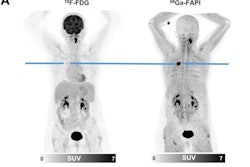
Future work should address the influence of neoadjuvant chemotherapy on FAPI uptake, as 86% of the patients in the study were imaged after chemotherapy, the authors suggested. They concluded that a head-to-head comparison with F-18 FDG-PET/CT also remains an important next step.
The full study is available here.